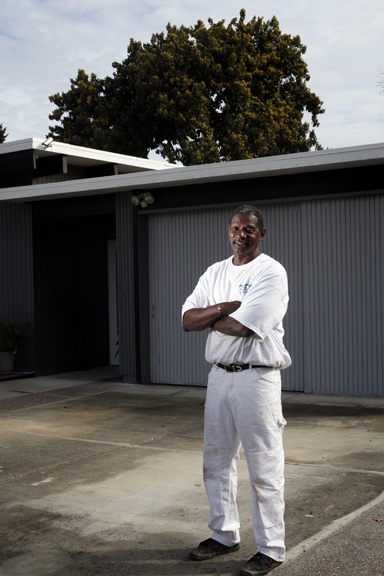
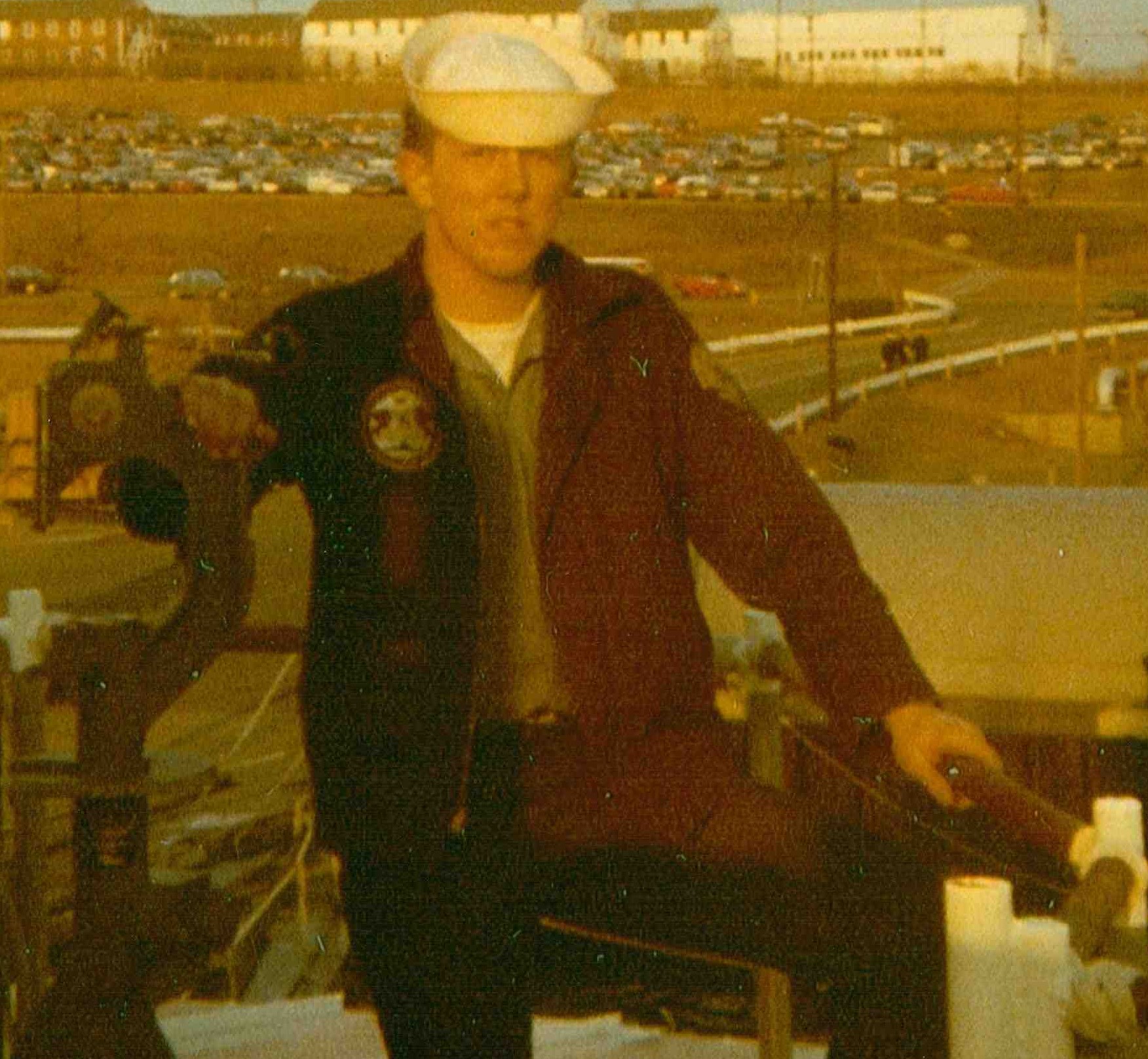
More than 40 years after he came home from combat, John Wayne Cloud is still walking point for fellow veterans

By Ken Olsen

(Copyright 2012 / All Rights Reserved)

To anyone except John Cloud, the Vietnam veteran’s case was hopeless. Johnny Pryor had gone AWOL three times, tried to kill himself twice, spent months in the stockade and was booted out of the Army. VA would never grant his claim. “We don’t take guys with bad discharges,” says Cloud, who has worked as a veterans service officer for nearly four decades. “I took him.”

Cloud soon learned that Pryor came home from combat to face his grandfather’s death, his parents’ divorce and his longtime girlfriend’s marriage to another man while Pryor had been clearing jungle and dodging enemy bullets. Friends who had gone to college to avoid the draft soon avoided Pryor. The public was hostile.

“He came home from Vietnam to the whole gamut,” Cloud says. “He wasn’t in his right mind, or he wouldn’t have tried to commit suicide.”

Eight years, two appeals and untold hours of paperwork later, Cloud won Pryor a better discharge and VA benefits based on an obscure 1940s law that gives veterans a break if they were mentally unstable when they committed the act that led to their bad discharge.

“Nobody else read my file,” Pryor says. “John Cloud took me under his wing and treated me with respect. He’s helped me every day since I met him.”

That’s how Cloud built a distinguished 35-year career with the Oklahoma Department of Veterans Affairs (ODVA) before retiring and becoming a volunteer service officer for American Legion Post 1 in Tulsa and the local VA Vet Center.
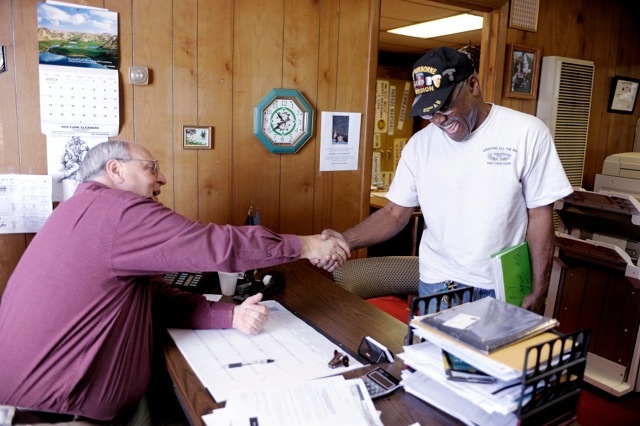
John Cloud welcomes veteran Cornelious Henderson to his office at American Legion Post 1in Tulsa. Cloud, the post’s volunteer service officer, is known for his tireless work on behalf of veterans who are trying to negotiate the VA system. (Photo Courtesy of Brandi Simons http://brandisimons.com/)

“People hunt for him,” says Sandra Oxford, manager of the Tulsa Vet Center. “They won’t let anybody else help them.”

The Brushoff

John Wayne Cloud served as an Army dog handler in Vietnam, walking point “for whatever outfit needed us.” He was drawn to veterans advocacy as a result of the brushoff he and his cousin received when they went to VA in 1969 to sign up for their GI Bill benefits. “We walked into that office, and there was a griping old federal worker who said, ‘All you Vietnam veterans want is something for nothing,’” Cloud says. “I told myself if I ever was in that kind of a position, I wouldn’t treat people that way.”

He earned a degree at what is now Northeastern State University and then bounced between oil-field and ranch jobs. He answered an ad for a service officer job at ODVA and started work in 1975 as a fieldman, helping veterans along a small-town circuit in southeastern Oklahoma. His ODVA career next took him to Muskogee, and by 1980 he was based in Tulsa.

Two years later, Cloud was looking for a new job. State wages were stagnant because of the oil bust, and he was exhausted from dealing with VA. “It was like a secret society you were fighting every day,” he says. “You were just beating your head against the wall with claims. And you’d go down to the hospital, and they wouldn’t even give you an aspirin.”

Cloud changed his mind about quitting after he found a poem lying next to the Vietnam Veterans Memorial at the 1982 dedication of the Wall. “The poem talks about the Wall and the names and said, ‘Make sure we didn’t die in vain. We died so you could make a difference.’” That was all he needed. “I thought, ‘I’m right where I need to be.’”

Tens of Thousands of Claims and Counting

Cloud has provided assistance for three generations in some families. He’s known for visiting homeless shelters, jails and any other places where veterans are in need. He prepared more than 80 emergency financial assistance applications in two days for veterans whose homes were damaged by the 1984 tornado in Mannford, Okla. Even VA employees seek Cloud’s help  filing claims – on behalf of their parents. Any notion of stopping, paycheck or not, is out of the question. “John thought he was going to retire – that was funnier than ever,” says Oxford of the Tulsa Vet Center. She recruited him as a volunteer after he left ODVA in March 2010, and Post 1 coaxed him into becoming a volunteer service officer.

When Cloud arrives at Post 1 on a spring morning, the lobby is filled with veterans waiting to see him. Two need help filing claims for hearing loss. One doesn’t have money to pay his water bill. Air Force veteran Thurman Phillips – the fifth or sixth visitor of the morning – walks into the cluttered, wood-paneled office, lowers himself into the chair before Cloud’s desk, leans in and says, “Can you call about my claim? I haven’t heard anything for a year.”
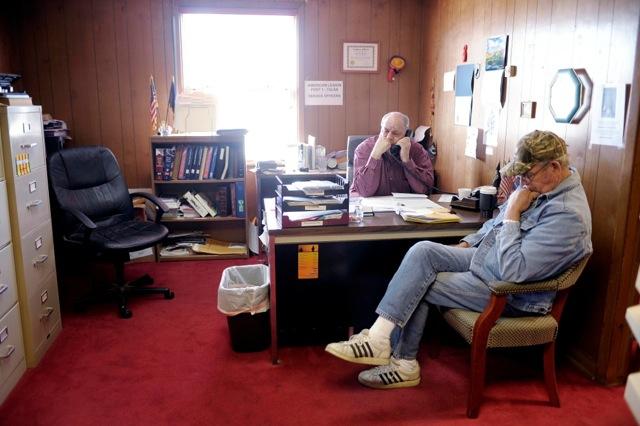
John Cloud works the phones, trying to help resolve Vietnam era veteran Thurman Phillip’s stalled claim.
(Photo courtesy of Brandi Simons http://brandisimons.com)

Cloud soon determines that Phillips’ claim for PTSD and ischemic heart disease is buried in VA’s bureaucratic snarl. “It went back to the rating specialist, and there it sits,” Cloud says after hanging up the telephone. “If you don’t hear by the end of April, we may have to go to the congressman to get this off high center.”

Cloud works the telephone, asks veterans questions, fills out claim forms, digs through his briefcase and scans the pink phone-message slips accumulating on his desk. He takes a quick break to help a veteran’s wife who needs provisions from the post’s food pantry until her husband is well enough to work. And then he goes right back to his desk to deal with the veterans still waiting to see him.

By noon, he has met with nearly a dozen veterans, putting to work his knowledge as a claims expert, talent as a counselor and passion as an advocate.

“John kept me encouraged,” says Cornelious Henderson, clutching a lime-green file folder with “Board of Veterans Appeals” written across the front. “I thank God for that.” He enlisted Cloud in his fight to get VA to upgrade his disability rating for the wear and tear he endured during his airborne career, including two tours in Vietnam.

“I had a lot of people at VA who had the gall to tell me they couldn’t do anything for me,” Henderson says. “If they had more men like John Wayne Cloud, more veterans would get their just due – not just their compensation but medical services.”

Textbook Definition

Sleepless nights and haunted dreams followed Cloud home from combat, as they did for innumerable Vietnam veterans. His response was typical. “When I got my paycheck, it was down to the bar I went. (Then) I found a woman who straightened me out. I went back to college.”

In December 2008,  Cloud helped start the Tulsa County Veterans Treatment Court, where former members of the military undergo treatment, rather than go to jail, for many nonviolent offenses. Cloud is one of four service officers on hand every Monday afternoon at court to help defendants file VA claims and access treatment opportunities, housing, job-training and education programs.

“A lot of these troops come back and may not know services are available to them,” says Tulsa County Veterans Treatment Court Judge David C. Youll, who served 23 years in the National Guard as a helicopter pilot. “Just getting hooked up with benefits they are entitled to has turned around a lot of lives.”

Cloud mentors about 15 defendants at any one time. He takes their 2 a.m. phone calls when they need someone to talk to. He helps them find rides to treatment or, in severe cases, food and shelter until they get on their feet.

“Even in court – if he sees a vet getting agitated about something, he takes them out in the hall,” says Matt Stiner, a Marine Corps Iraq veteran and director of the nonprofit Justice for Vets. He recruited Cloud to help start the Tulsa veterans court. “He instinctively knows this stuff.”

Wilbur Lunsford, who sought Cloud’s help with a hearing claim, is one of the Tulsa court’s success stories. He developed an attachment to alcohol about the same time he joined the Marines in the 1980s. The problem became severe after he returned to Oklahoma six years later. “Vodka was my favorite, but 100 proof wasn’t doing it for me,” he says. An arrest for marijuana landed him in Veterans Treatment Court.

Today, Lunsford has been clean and sober for three years, having graduated from the program in October 2011 and earning an associate degree in culinary arts in December. “If it wasn’t for that program, I would have done my time, got out and got back in trouble,” he says. “I probably would have ended up dead.”

The next morning, Cloud goes to the Tulsa Vet Center and helps a widow sort through piles of paperwork to file for benefits she had no idea were available to her. That includes a claim to cover some of her husband’s burial costs since he served 30 years in the Navy, including three tours in Vietnam, and died as a result of illnesses related to Agent Orange. “When in doubt, fill it out,” Cloud says, breezing through one of the multipage forms. “That’s been my policy for 40 years.

“I am so glad you came in today,” he tells the widow. “We are going to get all this done today.”

“John Cloud is the textbook definition of what it means to help veterans and their families,” Stiner says. “He has shown me what one person can do to affect tens of thousands of people.”

This story originally appeared in the September issue of The American Legion Magazine. Photos courtesy of Brandi Simons, copyright 2012, all rights reserved.

Posted in Uncategorized | Tagged , , , , , , , , , , , , , , , , | 5 Comments

Seconds to Win: For nearly 60 years, Wyoming veterans have helped develop some of America’s top rodeo talent

BY KEN OLSEN

(Copyright 2012, All Rights Reserved)

Emily Faber steps off her galloping horse, flies to the goat, flanks it, ties its feet and steps back. Time: 8.31 seconds – one of the fastest on this 98-degree summer evening at the 2012 Wyoming High School Rodeo finals.

“It’s amazing – like no other feeling,” says Faber, who loves the complex acrobatics of racing down the arena, dismounting, pinning and tying a goat more than any other rodeo event. “You have to be pretty strong. You have to be pretty athletic.”

Emily Faber expertly dismounts from her galloping horse during the goat tying competition at the 2012 Wyoming High School Rodeo finals. (Photo courtesy of Stephan Rennells)

A hundredth of a second can make the difference in Emily Faber’s efforts to win the goat tying championship. (Photo courtesy of Stephan Rennells)

And pretty determined.

“You can’t luck into goat tying,” says K.L. Spratt,  a fellow high school rodeo contestant. “You can’t buy your way into it with an expensive horse. You can’t throw a lucky loop. You have to put some time into it.”

For nearly 60 years, Wyoming high school students such as Faber and Spratt have competed to become the nation’s best goat tyers, barrel racers, calf ropers and bull riders, with help from The American Legion. The outgrowth of a competition started by World War II veterans in southwestern Wyoming in the late 1940s, this is the only state rodeo program backed by the Legion. The Wyoming contest produces some of the best rodeo talent in the country and thousands of dollars in college scholarships, as well as camaraderie, independence and confidence that will define these young men and women throughout their lives.

“There’s a lot stacked against you,” says Eric Oliver, a two-time Wyoming high school bull-
riding champion who went on to compete in college and on the professional rodeo circuit. “A guy learns how to deal with adversity. It’s a really good foundation. You won’t find many kids around rodeo who aren’t pretty solid.”

The contestants warming up their horses and roping arms at the Wyoming State Fairgrounds in Douglas on this June day hail from places like Lingle and Lance Creek, Cora and Kinnear, Rozet and Jay Em – spots on the map lucky to still have a post office. Their parents started them in rodeo as soon as they could walk.

“They sat me on horses pretty much from the time I could sit up,” says Spratt, who grew up on a ranch near Lysite. She was competing in junior rodeo at 7 and has qualified for the National High School Finals Rodeo three times. Spratt will take her four best rodeo horses to college in New Mexico this fall.

Relentless practice is a necessity. “I’m goat tying, roping, and riding my barrel (racing) horse every day I’m not at a rodeo,” says Faber, who has qualified for the national finals three times. “My dad makes every run feel like a national finals run. It’s not always fun. But if you can overcome the adversity, then it becomes fun.”

Shai Schaefer understands that theory while practicing goat tying in the 102-degree heat a few hours before the final evening performance. Why push that hard? “Anxiety and nerves,” says Schaefer, who won a national goat-tying championship in Colorado in 2009.

The physical challenges of rodeo are all but insourmountable, no matter the weather. Take steer wrestling. Austin Eller, who weighs 155 pounds, leaps from his horse onto a galloping 700-pound animal that he has to take down with nothing more than his arms and whatever brawn his lean frame can leverage. Half the battle is successfully executing the diving catch onto the running steer. Many contestants land face-down in the dirt. And connecting with the steer is a mixed blessing.

“Steer wrestling has been described like jumping out of a pickup going 40 mph and landing on a mailbox,” Eller says. “Only a steer is a lot bigger than a mailbox. It’s like tackling someone on the football field. You go all out and think about the pain later.”

Rodeo takes considerable mental discipline as well. Eller envisions every step of steer wrestling and calf roping over and over — until it becomes automatic. The goal, Faber adds, is to practice so much that muscle memory takes over when chatter from the announcer, music and the roar of the crowd threaten distraction.

Every move makes a difference. Winning and losing often is a matter of tenths or hundredths of a second. And it’s all on the individual. “These kids know there isn’t anybody who can cover for them,” says Casper College rodeo coach Tom Parker, who won the state saddle bronc riding competition in this same arena in the late 1960s. “You get one shot at it. You don’t have the opportunity to go behind the chute and regroup and go out and do it again.”

Rodeo is not a school-sanctioned sport. There’s no equipment provided, no team bus, no getting out of school early on a Friday to travel to competitions on the other side of the state. The program depends entirely on participants, their families and volunteers. It’s a substantial commitment. For example, Schaefer’s family drives 50,000 miles a year to rodeo events, often with four goats, three horses and two dogs in tow.

The payoff? “It’s a big accomplishment,” says Eller, who won the state steer-wrestling championship this year. “It’s the satisfaction of, ‘I came from a little old town, and I’m doing something big in the world.”

There’s also the knowledge that individual effort makes all the difference. “It’s all on you and your horse,” Faber says. “How hard you work determines how well you are going to do.”

Rodeo attracts exceptional students. The Wyoming State finals announcer introduces contestant after contestant by noting their academic honors. Participants submit school transcripts every semester to show they meet the minimum 2.5 grade point average. Many have straight A’s and excel in other sports as well as rodeo. Staying out of trouble is mandatory.

“There’s no alcohol, no tobacco and no drugs,” says Jim Whipps, a Vietnam War veteran who has served as The American Legion Department of Wyoming’s representative on the rodeo board since 2005. “If you get thrown in jail, don’t come back. Out of hundreds of kids in the past seven years I don’t think we’ve ever had a problem with more than one or two. Rodeo kids have to be smarter than the average bear.”

Ninety percent of Wyoming High School Rodeo participants go to college, estimates Parker, who also is a Vietnam veteran. He emphasizes education when he signs up students for his team. “The first thing I tell students is, don’t come to Casper College just to rodeo,” Parker says. “You’ve got to get an education.”

Rodeo helps pay the way. Parker attended community college and the University of Wyoming on rodeo scholarships. Many Wyoming High School rodeo participants receive similar help from Legion. “We give $20,000 to $30,000 a year in scholarships,” says Whipps, who chairs the high school rodeo scholarship committee and is credited with significantly increasing the Legion’s contributions. “Half of the 2012 scholarships were funded by The American Legion Department of Wyoming. That’s not good enough. I want the day to come that every kid who applies receives some money from the Legion so they can go home and tell their brother, who just came back from Iraq, to go join the Legion.”

Whipps is working to make that a reality. He solicits scholarship donations from Legion posts and donates a registered quarter horse to the Wyoming High School Rodeo contestant who sells the most fundraising calendars each year.

Faber, whose grandfather was a Korean War veteran and member of Post 70 in Judith Gap, Mont., is grateful for the help. “It was my goal to have college paid for with rodeo,” says Faber, who plans to study sports medicine and become a physician for rodeo athletes. “The Legion does so much for this rodeo association and for this state. And it does a lot for the youth of America.”

Jo Ann Merrit, who competed in Wyoming High School Rodeo from 1981-85 and now chairs the state high school rodeo board, agrees.  “I believe our high school rodeo is stronger than other states, and I believe The American Legion plays a huge role in that.”

Rodeo is a natural fit for Wyoming veterans. “This is the strongest youth organization the Legion can be involved with,” Parker says. “They step up and do whatever they’re asked. Every member of The American Legion in Wyoming has the same goal in mind – to help kids, support them and encourage them to become leaders.”

The Wyoming Legion does far more than fund scholarships. Legion members serve on the state rodeo board and turn out at state finals to help sort livestock, maintain animal pens and, in Parker’s case, judge bareback, saddle bronc and bull riding. Whipps and Past Department Commander Stephan Rennells are in front of the stands, selling raffle tickets to raise money for state and national high school rodeo on the final sweltering night of competition – after an exhausting week of helping other volunteers perform the hundreds of tasks that make rodeo competition possible.

Then there’s the small kindness that makes a significant impression. Post 5 in Torrington surprised Schaefer and 14 other contestants from southeastern Wyoming with funds to help them attend this year’s state finals. It wasn’t big money – enough for ice cream and dinner, Schaefer explains – but she and her fellow contestants were touched.

“We don’t have a club, and nobody in the community supports us,” she says. “It was really nice someone took the time to think of us.”

A version of this story first appeared in the September 2012 issue of The American Legion Magazine.

Posted in Uncategorized | Tagged , , , , , , , , , , , , , , | Leave a comment

Restorative Justice: Veterans treatment courts make differences in the lives of those who served

By Ken Olsen

(Copyright 2012, All Rights Reserved)

Glenn Slocum faced as much as 25 years to life after his arrest in late 2010 for stealing food and diapers. The Marine Corps veteran had two previous felony convictions for robbing stores, one in the 1970s and one in the 1980s. Petty theft was enough to put him behind bars for good under California’s three-strikes law, he was sure.

But when a judge learned that Slocum had served in the military, he sent him to Santa Clara County Veterans Treatment Court in San José instead. There, Judge Stephen Manley pushes Slocum and another 150 former servicemembers to undergo counseling, get clean and sober, and find a job or go back to school.

“I’m finally clean, and I love it,” says Slocum, who first developed a cocaine addiction in the 1980s. “I’m hooked up with the (VA) mental health clinic. I have a relationship with a beautiful woman who’s setting an example for me. I created my own little business last year.”

Glenn Slocum works as a handyman painting a neighbor’s home in San Jose, Calif. (Sarah Rice Photography)

San José’s veterans court is one of more than 80 specialty courts across the country that rehabilitate former members of the U.S. military, instead of leaving them to fend for themselves on the streets or tossing them behind bars. Judge Robert Russell started the first veterans treatment court in Buffalo, N.Y., in 2008.

Based on Russell’s model, veterans courts are a blend of mental health programs and drug treatment courts that have successfully reduced recidivism rates and lowered costs in the criminal justice system for nearly 20 years. They reduce the social costs of post-traumatic stress, alcohol abuse and other consequences of combat, according to judges, prosecutors and others involved with the courts. They also connect veterans to the benefits they’ve earned through their service, often with the help of American Legion service officers.

Veterans treatment court programs run as long as three years. Graduates can have their charges reduced or their criminal records expunged, depending on the rules of the individual court. “It’s a cost-effective approach for helping veterans,” says Matt Stiner, a Marine Corps veteran and director for the nonprofit Justice for Vets. “It solves a lot of the problems of homelessness, substance abuse and mental health disorders.”

“We did a terrible job of preparing to re-engage or help returning Vietnam veterans,” Manley adds. “We don’t need to repeat the mistakes of the past. VA has an obligation, the country has an obligation, and the courts have an obligation to help these veterans.”

Rules for Success

“Judge Manley Wants You to Succeed,” declares a sign at the back of the courtroom, which is housed in a former factory. He opens every session by reiterating that message. Then he reminds everyone of the rules: stop using drugs and alcohol, stay in treatment, be polite, don’t run other people down.

“The final rule,” Manley says, leaning forward as if to add emphasis, “I don’t like excuses. I like the truth. The more honest you are with me, the less time you will have to spend in jail.”

Manley knows whether or not defendants are straight with him. He meets with the district attorney, the public defender, VA representatives and treatment staff to assess the progress of each veteran a few days before his court appearance. That includes reviewing reports from doctors, substance-abuse counselors and probation officers.

Judge Stephen V. Manley listens to a defendant during veteran’s court in his courtroom at the Santa Clara County Superior Courthouse in San Jose, Calif.
(Sarah Rice Photography)

On court day, defendants come forward one at a time. Each takes a seat at a table with the counselors and therapists who are part of Manley’s team. A half-dozen VA psychologists, social workers and benefits counselors also stand by to help defendants connect with VA treatment programs and find subsidized housing and other federal assistance.

Manley engages each veteran with questions specific to his or her circumstances. Did you get your medication refilled? Why aren’t you in treatment? Do you need help with transportation? The judge reviews the number of substance-abuse rehabilitation meetings each veteran is attending. He tracks the community-service hours performed, and takes note of any domestic violence, anger management or PTS programs they complete.

Manley doesn’t automatically kick out defendants who fail drug tests. “We’re a more therapeutic court,” he says. “We will go to far greater lengths to get people to succeed.”

Manley also encourages veterans to talk to him about their needs and problems. Several inquire about help with housing. Manley turns to a VA representative, who says that subsidized housing vouchers are again available. “She will help you,” Manley tells the veteran.

When Slocum comes forward, Manley asks him about the home-exterior business he has started – a one-man power-washing, landscaping, painting and handyman operation.

“Are you having challenges?” Manley asks. “Is it the weather?”

Things are slow, Slocum says. He expects spring will be better. “You are going to lots of meetings,” Manley says with encouragement. “Keep up the good work.”

Slocum is assigned his next court date, and the courtroom is filled with applause in accordance with another Manley rule: “Clap for everyone, whether this is the beginning or the end, whether people are doing well or not.”

To Stop the Cycle

Manley created the Santa Clara County Veterans Treatment Court in November 2008 after seeing a long line of former servicemembers cycle through the criminal justice system and end up living on the streets because they weren’t getting treated for substance abuse and PTSD – or because they dropped out of treatment.  “One way you stop recidivism is to treat people,” Manley says. “That’s why these courts work. I don’t allow people to drop out.”

Manley also makes certain that veterans always have treatment options. If there isn’t room in a VA facility in Santa Clara County, veterans are sent to VA facilities in neighboring counties. If defendants don’t qualify for VA health care or don’t want to deal with VA, Manley sends them to the county’s treatment programs.

Demand for veterans courts nationwide is growing. But it’s difficult to expand the program, given VA’s limited resources. The federal government will have to provide additional funding to meet the surge of demand from returning Iraq and Afghanistan veterans, Manley says. ” If you are going to spend money for wars, you are going to have to invest in re-entry and treatment for returning veterans,” he adds.

The Santa Clara County court differs from other veterans courts in one important regard. Manley accepts all veterans, no matter the terms of their discharge, their crime – about one-third are charged with violent offenses – or whether they served in combat. “You don’t decrease recidivism when you deny services to people who need help,” Manley says. “If we don’t address it now, are we going to wait until there’s another crime? That doesn’t make sense.”

“The Best Thing is … I’m Alive”

Four hundred miles to the south, the Orange County judicial system takes a more restrictive approach. It requires that a defendant’s alleged crime be tied to military service – for example, a consequence of PTSD – for them to qualify for veterans court. That generally means that a defendant cannot have a criminal record prior to joining the military.

Nevertheless, the program has made a significant difference for veterans who had all but given up on their lives. Take Jacklyn Gebhard, the first female defendant in the Orange County Combat Veterans Court.

Gebhard doesn’t talk about the incidents that drove her to heroin addiction. Suffice it to say that the former Air Force military policewoman was so down and strung out that even the bookstore security staffers who busted her for grand theft in April 2010 tried to persuade her to get into a recovery program.

“There were a lot of things going on in my life, and I didn’t know how to deal with it,” says Gebhard, who was stealing CDs and DVDs to support her drug habit. “I needed to use heroin in order to wake up in the morning. I needed to use in order to be normal the next day.”

Gebhard kicked heroin in jail, and she’s getting her life back through veterans court. The court sent her to inpatient drug rehabilitation and helped her find housing after she completed that program. She still attends outpatient drug rehabilitation and enrolled in an all-women’s sexual trauma treatment program at the Long Beach VA Medical Center, to deal with events she says occurred while she was in the military. She will not elaborate, focusing instead on the fact that she’s now a straight-A college student with plans to get a degree in social work and help other veterans.

Gebhard’s mentor, California Courts of Appeal Justice Eileen Moore, says the change in Gebhard’s self-esteem is profound.

“I’m proud of her,” Moore says. “I feel fortunate to have her assigned to me.”

Treatment courts often recruit veterans such as Moore, who served as an Army nurse in Vietnam, to mentor former servicemembers who get into trouble. Volunteers from The American Legion, Vietnam Veterans of America and other veterans service organizations are a significant part of the effort.

Moore has coffee, lunch and frequent telephone conversations with Gebhard. She is also the first person Gebhard called when she was wrongly arrested for allegedly being under the influence. When it looked like she would go to jail while the judicial system sorted out the situation, Moore gave her a hug and told her, “I don’t know what’s going to happen, but I believe you.” A blood test showed that Gebhard was clean.

“It felt good to have someone believe in me and have my back,” Gebhard says.

Like many veterans, Gebhard was wary when she first heard about veterans court. Today, she’s enthusiastic. “I have a place to live,” she says. “I’ve started to trust people. I’m building relationships. The best thing is, I’m alive.”

Judicial Attitude

Veterans credit the success of these specialized courts to the attitude and understanding of judges who oversee them. “I thought I was going to get locked up – I gave them a dirty test,” says Harold Thomas, a Vietnam combat veteran who didn’t realize he had PTSD until he landed in veterans court three years ago for possession and use of methamphetamine. “Judge Manley told me to keep trying. He said, ‘It doesn’t do you any good to be in jail.’”

Thomas kept trying, and graduated from Santa Clara County Veterans Treatment Court in late January, a few weeks after his 62nd birthday.

“This was a good birthday present,” Thomas said as he left the court.

Judge Stephen V. Manley congratulates Harold Thomas after he graduated from the veteran’s court program in his courtroom at the Santa Clara County Superior Courthouse in San Jose, Calif.
(Sarah Rice Photography)

Eric Norton, meanwhile, is surprised by the amount of individual attention he receives from the court. “I didn’t know I would come here every month and work on my problems,” he says. Norton’s problems included a domestic violence charge for an incident he does not remember.

“I had a flashback and blacked out,” says Norton, who served in Iraq and Afghanistan with the Marines. “To any cop, I’m a psycho. The judge is like, ‘OK, you’ve had a flashback. You’ve got to get into counseling.’”

Norton has had difficulty getting VA treatment for his PTSD because he got into a fight with an MP near the end of his Marine Corps hitch and received an other-than-honorable discharge. His wife died of liver failure last June, leaving him a single father of their 2-year-old son. Manley’s team helped find child care so that Norton could keep his job as a sheet-metal worker and attend anger management counseling. They also found an advocate to work on getting his discharge upgraded. “It’s a different mindset,” Norton says. “Judge Manley takes a lot of the stress off.”

Slocum, meanwhile, is looking forward to expanding his home-exterior business when he graduates from Santa Clara County Veterans Treatment Court. “I plan to get married,” he says with a proud smile. “I’m in a church now, and I’m really digging it.”

“I’m finally happy,” he adds. “What little I’m doing now is so much more than what I was doing before.”

This story appeared in the July 2012 issue of The American Legion Magazine. All photos by Sarah Rice Photography

Posted in Uncategorized | Tagged , , , , , , | Leave a comment

Rare Victory: Vietnam Navy veterans struggle to prove, and keep, Agent Orange benefits

By Ken Olsen

(Copyright 2012, All Rights Reserved) 

Surgeons started removing strange growths from Mark Crosbie’s body a few years after he came home from Vietnam. Over the next three decades, they took sebaceous cysts from the Navy veteran’s back, and one from his elbow. They removed a growth that had spontaneously developed under the skin of his left cheek and abscessed. They performed fistula removals too painful to discuss.

Two of the surgeons asked Crosbie if he had served in Vietnam. But they wouldn’t elaborate when he asked why they seemed to associate the cysts with his tour in Southeast Asia.

As a result, Crosbie didn’t pursue a connection between his health problems and his service until he went to VA for help with his type 2 diabetes in 2003. The first VA doctor he saw told him she suspected he’d been exposed to Agent Orange. She insisted he receive an evaluation from an environmental medicine specialist and file a claim.

By that time, Crosbie suspected his cysts and his wife’s half-dozen miscarriages were related to herbicide exposure during his 20-month tour on USS Lloyd Thomas in and around the waters of Vietnam. He couldn’t apply for federal benefits for either health problem, since VA doesn’t recognize them as Agent Orange-related illnesses. But he could file a claim for type 2 diabetes and neuropathy.

“That’s when I started running the gantlet,” Crosbie says.

Mark Crosbie aboard the U.S.S. Lloyd Thomas ready to go to sea. (Photo Courtesy Mark Crosbie)

VA rejected Crosbie’s claim twice over the next six years. He’d never stepped foot in Vietnam, and therefore didn’t meet the “boots on ground” requirement for Agent Orange disability benefits. He also couldn’t find records to prove that his ship had sailed up a Vietnamese river on a covert mission in December 1970. That would have made him a “Brown Water” veteran – someone who had spent time in Vietnam’s inland waters, which VA acknowledges were contaminated by Agent Orange.

Crosbie had given up, when he connected with shipmate Charles Yunker, adjutant of the Legion’s Department of Kansas, online. Yunker was trying to prove that Lloyd Thomas had been on that covert mission on a Vietnamese river as more and more of its crew contracted cancer and other illnesses tied to Agent Orange exposure.

With the help of the ship’s navigator, Mike Balog, damage control officer Rick Hokans, deck division officer Bob Moore, and John Delgado of the Australian Special Air Service, who was on board during the mission, Yunker was able to establish that Lloyd Thomas had anchored in the heavily contaminated Gành Rái Bay and Saigon River estuary in late December 1970. That, along with evidence from the ship’s deck logs, qualified Lloyd Thomas for VA’s list of Brown Water ships.

USS Lloyd Thomas

USS Lloyd Thomas

Yunker, along with Kansas American Legion service officer Bruce Oakley and Boston service officer George Cameron, helped Crosbie file a new claim in 2010. In December, eight years after filing his first claim, VA finally granted Crosbie’s Agent Orange claim for type 2 diabetes and neuropathy based on the new evidence Yunker unearthed.

“Legion to the rescue,” says Crosbie, a member of Alberton W. Vinal Post 313 in North Chelmsford, Mass. “Without Chuck and the Legion, I and all my shipmates would have been left out in the cold.”

Crosbie’s battle is typical of what Vietnam Navy veterans endure when they file claims for the cancers, type 2 diabetes and Parkinson’s disease linked to Agent Orange. The Agent Orange Act of 1991 provided benefits for all Vietnam veterans with diseases caused by the toxic herbicide. But the Bush administration changed the rules in 2002 so that only veterans who can prove they stepped foot in Vietnam or sailed on Vietnam’s inland waters qualify.

Mark Crosbie served aboard the USS Lloyd Thomas from 1969 to 1971, including a tour in the waters of Vietnam. (Photo courtesy of Mark Crosbie).

Proposed new legislation to restore Agent Orange benefits for Navy veterans who were on ships operating within 12 miles of Vietnam during the war won’t simplify the claims process, says Jeff Davis of the Veterans Association of Sailors of the Vietnam War.

Under H.R. 3612 – the Blue Water Navy Vietnam Veterans Act of 2011 – many veterans will still be forced to find the deck logs in the National Archives or Navy archives that establish that their ship meets the criteria for exposure. That’s an undue burden that puts claims out of reach for most of them.

The legislation also faces considerable hurdles. “I think our real challenge right now is maintaining the benefit we have,” says Sen. Patty Murray, D-Wash., chairman of the Senate Veterans Affairs Committee. There was an effort last summer in Congress to limit Agent Orange benefits. “We beat that back … but the people who believe that we should not be funding (Agent Orange benefits) are going to be back at us, particularly in tight budget times.”

Last year’s assault on Agent Orange benefits was led by Sen. Tom Coburn, R-Okla., who criticized VA’s 2010 expansion of Agent Orange benefits to include ischemic heart disease, Parkinson’s and B-cell leukemia. Two Vietnam veterans – Sen. John McCain, R-Ariz., and Sen. Jim Webb, D-Va. – also criticized Agent Orange benefits.

Vietnam Navy veterans also continue to run into problems at VA, which has not, as of this writing, provided information requested by Sen. Daniel Akaka, D-Hawaii, on the number of Brown Water cases it has reviewed. Akaka asked for the review in September 2010 after his staff discovered that VA had rejected claims from 16,820 Vietnam Navy veterans without reviewing ship logs or other evidence showing that the veterans had served in areas that may have been exposed to Agent Orange.

In April 2011, VA officials said that about 6,700 cases had been reviewed and 20 ships added to the Brown Water list.  VA says it cannot provide an estimate of how many additional cases it has reviewed since last year because of the significant growth in all claims, including Agent Orange cases. The agency also would not estimate when it will complete the review of mishandled Brown Water cases that Sen. Akaka requested nearly two years ago.

Other members of the Lloyd Thomas crew, meanwhile, are now pursuing claims. Crosbie warns that they should be prepared for a long and frustrating process – one that, in his case, eventually ended in victory.

A version of this story first appeared in the June 2012 issue of  The American Legion Magazine.  To read more about U.S. veterans and Agent Orange exposure see these other Veterans Voices stories: Brown Water Bungle: Paperwork error excluded hundreds of Vietnam Navy veterans from receiving Agent Orange Benefits;  Sailors Adrift: The Lingering Tragedy of Agent Orange  and Still Adrift as well as Toxic Legacy: A Brief History of Agent Orange Exposure in Vietnam,  and Brown Water Update: VA Partially Addresses Bungle that kept Vietnam Navy Veterans from Receiving Benefits.

Posted in Uncategorized | Tagged , , , , , , , , , , , , , , , , , , , , , , , , | 2 Comments

Veterans helping veterans: Disaster response team, coffee house launch Portland partnership

Team Rubicon, the innovative veterans group that has been making its mark on disaster response since the 2010 Haiti earthquake, is opening an office at the NorthStar Coffee House in Portland June 9. NorthStar will donate 5 percent of its revenue to Team Rubicon’s Region 10 operation as part of this new partnership. Grabbing an Americano, latte, Morris Brothers icer or other NorthStar offering helps military veterans perform volunteer disaster relief work across the nation and around the world.  Team Rubicon’s regional leaders will be on hand for this kick-off event, which includes live music and runs from 9 a.m. to 1 p.m. Saturday. Drink it all in at the corner of Lombard and Interstate.

Posted in Uncategorized | Tagged , , , | Leave a comment

Road to Nowhere: Returning veterans face the worst job market of their lives.

By Ken Olsen

(Copyright 2012, All Rights Reserved)

Kai Jorgensen was laid off just before Thanksgiving 2011, the third time the recession has cost him his job since he left the Marine Corps in May 2009. He wasn’t prepared for such a cold reception from the civilian world after four years of keeping troops on the front lines supplied with gear and working as a ground safety officer.

“I didn’t expect this at all, especially coming out in the field of logistics,” says Jorgensen, 25, a Beaverton, Ore., native who has applied for hundreds of jobs. “I’m very discouraged.”

Yet, the fact that Jorgensen has found any employment – even minimum-wage work – makes him one of the more fortunate returning servicemembers. The job hunt has been even more difficult for Oregon Army National Guardsmen like Shad Vaughn. Half of the soldiers in Vaughn’s company didn’t have jobs when they came home in April 2010 after a yearlong deployment to Iraq, he says.

Vaughn’s family has lived off credit cards and hardship grants – and his children are on state assistance – while he looks for work and fights to get medical care for injuries he sustained when an 850-pound armored-vehicle tire fell on him three weeks before he left Iraq. “For guys who have not been hurt, it’s hard,” Vaughn says of the job search. “For guys who are hurt, it’s ridiculous.”

The men and women who have served since 9/11 have the highest unemployment rate among their peers, according to a 2011 congressional study. The magnitude of the problem is often understated, because the most commonly cited government numbers don’t tell the whole story. The U.S. Bureau of Labor Statistics is often quoted as estimating unemployment among returning veterans 18 to 24 at about the same level as nonveterans in that age group.

But Bloomberg News dug deeper into the government data and found a far grimmer picture. Veterans 18 to 24 had a 30.4-percent jobless rate as of October 2011, about double the unemployment rate of nonveterans in the same age range. That’s also a significant jump from the October 2010 unemployment rate of 18.4 percent among the youngest veterans, Bloomberg reported. Black veterans 18 to 24 were faring the worst, with a 48-percent jobless rate.

Fleeting Success

Jorgensen’s initial return to civilian life was more promising. He found work as a loss-prevention agent for a major department store soon after leaving the Marines but was laid off a year later. “Since then, it’s been real hectic and hard,” he says.

He found a no-benefits job driving a delivery truck in September 2010 but was laid off right after Christmas that same year. He turned to a minimum-wage job at a golf course and enrolled in college. Although he was told there was room for growth, Jorgensen soon discovered that people with four years at the golf course were only making an additional 50 cents an hour. “I decided to continue school without that distraction,” Jorgensen says. The decision came after he realized that he was barely earning enough to pay for his gas to drive to work. “A lot of us who spent four years on active duty don’t have a college degree, although when I read the requirements, I know I can do a lot of the jobs (that call for a degree).”

His luck appeared to turn in September 2011, when he found a job as a delivery driver and warehouse specialist. That ended shortly before Thanksgiving because the company lost a major contract due to government cutbacks.

“It’s gotten to the point I’m applying for jobs all over the country,” Jorgensen says.

Vaughn doesn’t have that option. A .50-caliber gunner and mechanic, his six-year hitch with the National Guard runs until 2015. Meanwhile, in addition to looking for work, he is focused on some missing paperwork that’s made it nearly impossible for him to get treatment for back, neck, shoulder and other injuries he suffered when a tire fell 14 feet from a forklift and knocked him unconscious near the end of his tour in Iraq.

The Army put him on light duty and told him to wait to seek treatment until he got home, Vaughn says. Once his unit returned to the United States, he went to VA, where his claim has been stalled because of the missing paperwork, he says. His primary-care physician, meanwhile, dismissed his complaints of neck pain without obtaining a CT scan that would later show fractured vertebrae.

“We’ve been fighting tooth and nail to get records of my injuries the last two years,” Vaughn says. “It’s been rough, especially for my wife and two kids. The sad thing is, I know there are a lot of guys out there with the same problems, but they don’t want to get involved in it. I can’t give up because I’ve got so much invested in it.”

American Legion service officer Gregory Demarais became aware of Vaughn’s case in early December and worked to push forward his VA disability claim. Demarais also secured temporary financial assistance through the Legion to help pay Vaughn’s rent, and obtained donations for Christmas presents for Vaughn’s family through The Salvation Army, American Legion Post 122, the American Legion Auxiliary and VA employees. This is nothing out of the ordinary for Demarais. He distributed $19,000 in emergency funding to unemployed Oregon veterans in the first 10 days of that month alone.

National Attention

Meanwhile, there are efforts in Washington to deal with the problem. The Legion and other organizations successfully pushed Congress to pass the Hire Heroes Act late last fall. The legislation gives private businesses up to $5,600 in tax credits for hiring unemployed veterans, and as much as $9,600 to businesses that hire unemployed veterans with service-connected disabilities.

The Obama administration has also increased the number of veterans working for the federal government, despite an overall hiring decrease. The Defense Department, VA and the Department of Homeland Security employ the most veterans of any federal agencies. In late February, the U.S. Department of Agriculture signed a memorandum of understanding with The American Legion to launch a nationwide veteran-hiring initiative that aims to employ veterans in rural areas. VA has increased its veteran-employee numbers from 59,563 in fiscal 2004 to 101,651 in fiscal 2011. Veterans now make up about 29 percent of the work force at U.S. Customs and Border Protection (CBP), an arm of Homeland Security. CBP added more than 800 veteran employees each of the last two years alone with an aggressive recruiting program, says Judy Hatter, who oversees veteran recruiting for the agency. That includes more than 340 job fairs and other events aimed at attracting applicants with military experience.

USAJOBS, an online application program that is mandatory for most federal jobs, is notoriously confusing and time-consuming, according to many government job seekers. CBP sets up laptop computers at job fairs and walks veterans through the process. The Department of Homeland Security has also established a Warrior Transition Program that allows it to bypass USAJOBS and hire qualified veterans for some positions. The USDA initiative also envisions a more streamlined application process for veterans seeking particular jobs.

Doug Peters, a Marine Corps veteran who participated in the invasions of Afghanistan and Iraq, found a home at CBP last September. His advice to veterans: “Make every effort to go to school, even if it’s part-time, even if you have to work a job and take night classes.”

Peters’ experience, however, demonstrates that education alone isn’t enough. He earned a bachelor’s degree in history and a law degree after leaving the Marines in 2003. Even then, it took him 18 months and hundreds of applications to find a job after he graduated from the University of Detroit Mercy School of Law in May 2010.

“I was really having a difficult time even getting people to call me back,” says Peters, 32, now a labor and employee relations specialist with CBP in Washington. His break came when a representative from Naval District Washington’s Wounded Warrior Employment Program forwarded his résumé to CBP.

Combat Experience Wanted

Customs and Border Protection isn’t the only place where veterans are valued. West Coast-based private employer Vigor Industrial hires veterans because the ship-repair company values their technical skills as well as their ability to think quickly, ask questions and make suggestions.

“Veterans, especially people who have experienced combat training or combat, are well suited for ship repair,” says Daava Mills, a corporate recruiter for Vigor. “Things turn on a dime.”

The company does short-notice ship repair for everyone from oceangoing cargo companies to the U.S. Navy. That can mean showing up at 2 a.m. to get a ship in dry dock. “We have to make our deadlines, or companies have to rent ships,” Mills says.

The company’s employees range from Vietnam War veterans to men and women who recently returned from serving in Iraq and Afghanistan. They hold jobs from general labor to director of operations. Even the laborer jobs are not typical, Mills says. Workers have to be able to read blueprints and perform other technical tasks, such as figuring out how to safely block up a ship in dry dock. Veterans often have these skills.

Many of the veterans working at Vigor were Navy or Air Force avionics and electrical specialists. Because they are doing maritime electrical work, they are not required to get additional state licenses to work for Vigor. That’s an important advantage for veterans, who often find employers don’t recognize their military licenses because of state and federal regulations.

Mills personally understands the challenges veterans face finding work. Her father struggled to find meaningful employment after 24 years in the Air Force, including a tour in Vietnam.

“He went from planning missions and planning wars to packing boxes, so I have an appreciation for what these guys go through,” Mills says. “Unfortunately, we aren’t in a position to hire all of the guys and girls who come home.”

Older veterans are also struggling. Tony Hoffman has applied for jobs with VA in Florida and Indiana for more than a decade, and he’s only landed one interview. Instead of a job, he says, VA offered him a volunteer position passing out magazines and pencils.

“I go up there every time there’s an opening,” says Hoffman, who served as a licensed practical nurse in the Army from 1984 to 1991. “I have an Expert Field Medical Badge. I ran a clinic in the Army for two and a half years. They said they didn’t understand all of that. I can qualify to work as a janitor, but not as a nurse who can start IVs and has skills above and beyond the average LPN. It’s disheartening.”

Hoffman worries about the hurdles facing job-seeking veterans who served in Iraq and Afghanistan. “There’s going to be a whole lot of medics coming home soon,” he says. “I think the young guys are going to get discouraged.”

Robert Randy has been so dismayed by his job searches that he’s considered leaving his four years with the Marine Corps off his résumé to see if it makes a difference. He earned a degree in international business after getting out of the service in 1990, and worked at a variety of companies until opening three cellular telephone retail stores in San Diego. Two of the stores went out of business after the economy soured. He sold the third after his wife landed a job in Oregon in 2007. He hasn’t been able to find a job since, even after applying for work as a state and county veterans service representative.

“I don’t know what I am going to do from here,” Randy says. “I want to work. I need to be able to work for my health.”

Veterans like Vaughn and Jorgensen also find it difficult to be optimistic. “It’s been one battle after another from every which way,” Vaughn says. “There’s no reason for the guys coming back to get this much crap.”

Jorgensen just wants the opportunity to get beyond the typical computer application process to sell himself in person.

“You want to come back, help your community, get an education, start a family,” Jorgensen says. “For me, it would be great just being able to get into the interview process. I think if I could just get face to face with employers, I could get a job.”

This story appeared in the May 2012 issue of The American Legion Magazine.

Posted in Uncategorized | Tagged , , , , , , , , , , | Leave a comment

A Heart Apart: Interactive book gives children, military parents safe way to share feelings about the difficulty of deployment

 By Ken Olsen

(Copyright 2012, All Rights Reserved)

Melissa Seligman knew she had to help her children find their emotional voices. Her daughter’s depression spiked to near self-destructive levels when her husband deployed. Her son’s anxiety was gut wrenching.

“We have never asked military children to go through repeated, continuous goodbyes,” Seligman says. “We need to give them the freedom and opportunity to say, ‘I hurt.’ We don’t know how to help our kids until they can tell us what they need help with.”

Seligman teamed up with Christina Piper to create A Heart Apart, a book that children customize with their own photos and text to reflect what they are feeling when their father or mother goes to war.    

“There’s not a lot out there to tell you what kids are going through,” says Piper, who, like Seligman, is an Army wife and mother of a boy and a girl. “What’s unique about the book is that it gives a child words to talk about what’s happening. And it helped me to talk to them about what they were feeling.”

Children build their own copy of the book in tandem with their parent who is going to deploy. A website guides them through creation and illustration of their story. For example, one page has a child and his parent complete these sentences: “Sometimes I feel (emotion) when (family member or friend) is gone. I also learn new things and enjoy (fun activity) while (he or she) is gone. I know that (family member or friend) is always proud of me and loves me very much.” The child selects a photo to put on the facing page to remind them of something they do that is fun – such as fishing – while their parent is away.

“The process is as important as the product,” Seligman says, “It’s a way for them to tell you how they feel without looking you in the face and feeling intimidated.”

Military children are given vouchers that allow them to access the software to build the books. Civic groups and veterans service organizations have donated funds to cover the cost of most of the books printed to date. Once the book is completed, the publisher prints two copies – one for the child and one for the deploying parent.

“For my daughter, getting her book in the mail and seeing her picture with her dad – the emotions and the conversations that ensued – were amazing,” Piper says. “My son drags his to bed every night.”

Teachers and school administrators near Fort Riley, Kan., where Seligman’s family was stationed when the book was first published in April 2010, praise A Heart Apart.

“It’s all about them and their dad and nobody else,” says Shannon Rolfs, a student support monitor at Spring Valley Elementary School, which received book vouchers for 100 students courtesy of the Junction City, Kan., Breakfast Optimist Club. “It’s a connection that keeps them close.”

Flo Gatsche, who teaches first grade at Eisenhower Elementary School in Junction City, knew she had to get her students copies of the book when she discovered A Heart Apart.

I wanted a book that explained deployment and the feelings and emotions that went with it,” Gatsche says. “It allows them to put their family member and themselves in a book and yet know that their feelings and emotions and experiences are universal.”

She knows the life of a military child first hand. Her father went to Vietnam with the Army when she was growing up in Kansas.

Gatsche’s students love A Heart Apart as well. “The kids were excited to see a book that dealt with deployment,” she says. “Because it’s not like you can go to the library and get a book about deployment.”

 Future production of the book is uncertain and Seligman and Piper search for a new publisher to keep the project going.

“My dream is A Heart Apart would be in the hands of every military child between the ages of 2 and 10,” Seligman says. “The youngest child can feel loss, can feel anger, can feel sadness. It’s our job to help them through it.”

This story appeared as a sidebar to The Hardest Year: Children Endure the Stress of Parent’s Deployment. Read more of Ken Olsen’s stories about the challenges military families face on this website, including America’s Forgotten Military FamiliesGuard and Reserve Families Serve in IsolationFamily Considers Leaving Military After Enduring Multiple Combat Deployments and other stories from the Behind the Blue Star series.

Posted in Uncategorized | Tagged , , , , , , , , | Leave a comment

The Hardest Year: Military Children Endure the Stress of Parent’s Deployment

By Ken Olsen

(Copyright 2012, All Rights Reserved)

Jack Crider hit a wall during his father’s third deployment.

It wasn’t just his father’s absence, or the prospect of him dying in Iraq. It was the unexpected move, from Virginia to Georgia, that meant the young boy was dealing with his fourth new school just as he started second grade. It was leaving his friends again. It was being the new kid in an unfamiliar neighborhood again. It was the stress of being a military kid who has never known a time without war.

“It was a collision of all of these factors – the perfect storm – at a time when he needed to be connected to his dad,” Jill Crider says of her son, who was 8 when his father, Col. Jim Crider, left for his third combat tour in 2009. “He went from a child who loved school to a child who would wake up crying and beg me not to take him to school.”

Soon, she was dropping him off at the school and, by the time she returned home, someone was calling to say that Jack was in the counselor’s office, distraught. “I never saw it coming until it was full in my face,” Crider says. “I was brokenhearted.”

The difficulty the Criders faced resonates with military families across the country as children deal with repeated deployments and the stress borne by parents who are left behind.

“The deployment of military parents is taking a toll on the mental health of children,” says epidemiologist Alyssa Mansfield, who analyzed the medical records of more than 307,000 Army children in the most comprehensive study to date. “The longer the deployments, the more problems children experience.”

No one knows what the long-term consequences will be. “I’m just afraid we don’t know how much is too much,” Crider says, “until it is too much.”

Stress Points

The medical community is noticing the strain. Active-duty Army children whose parents deploy are more likely to experience depression, anxiety and other mental health challenges than children whose parents don’t deploy, according to Mansfield’s analysis of their medical care from 2003 through 2006.

Overall, there were more than 6,500 additional mental health cases among children of deployed parents during the four years of the study. The results are conservative, given that Mansfield’s study was limited to children 5 to 17 whose parents had been in the military for at least five years, and only included children who had received diagnoses for mental health problems. “I wouldn’t be surprised if this number was three or four times higher,” says Mansfield, who conducted the research at the University of North Carolina before taking her current job with VA’s National Center for PTSD.

Boys appear to handle the strain of repeated deployments worse than girls. Older children have a tougher time than younger children. “Older children probably have a better understanding of exactly what’s happening when their parent deploys,” Mansfield says.

Crider saw her son’s reactions change over time. When he was 5 and his father was serving his second deployment in Iraq, Jack matter-of-factly asked her, “What happens if Dad gets killed?” Although she nearly ran off the road when her son lobbed that question from the back seat of their car, Crider was able to reassure Jack, and he never broached the subject again. But when his father was back in Iraq three years later, her son’s resilience evaporated.

“At 8, it’s different,” Crider says. “He starts to feel the responsibility of being a young man. I think his security was threatened when I had a bad day or felt sad. And I never realized how much he would miss his dad.”

By the time her husband came home on R&R, the situation was serious. “Nothing says ‘welcome home’ like ‘Get in the car, we’re going to see the school counselor,'” Crider says.

The strains Jack Crider and other military children experience go far beyond what most civilian children face.

“People should be very cautious in trying to compare military children to civilian children, because deployment is unique to military children,” says Mansfield, whose study of military children appeared in the Archives of Pediatrics & Adolescent Medicine. “Trauma and stress are not unique to military children. But deployment is a very different kind of stressor. It’s chronic, and it’s repeated, and it involves long periods of time. It also potentially involves the stress of their caretaker.”

Crider can relate. She worries that Jack absorbed her stress from previous deployments. Her father died, and her nephew and a close friend were killed in accidents, during her husband’s first combat tour in Iraq in 2003. Her 80-year-old mother was also hospitalized. During the next deployment, Crider served as Family Readiness Group leader for her husband’s battalion, part of a brigade that had more than 100 soldiers killed during its 15 months in Iraq. She also fell down a flight of stairs and broke her ankle. Then on the eve of her son’s birthday party a month later, Crider was hospitalized with a brown-recluse spider bite.

“I think there also was a delayed response to all of the stress of the (previous) deployments,” Crider says of her son reaching his limit. “I sat there and I wondered, ‘How much of this is my fault because I’m not handling this deployment well? How much of this is because I’m tired at the end of the day?'”

Separation Anxiety

Some children experience problems as soon as their military parents begin deploying. Maj. Vinston Porter’s daughter broke down the first time he went to Iraq.

“She was aware of the dangers of Iraq, and she knew that it meant Daddy was going away for a long time,” Porter says about Rylei, who was 4 at the time.

Porter’s wife, Stacey, found a private counselor to help Rylei. That counseling continued after Porter returned to Fort Stewart, Ga., and throughout his second deployment. He participated in the sessions with his wife and his daughter when he was home. “It was helpful to get tools and to address the situation for my wife and I and our daughter,” he says.

Porter’s son Blake, then 2, didn’t have the same outward emotional reaction to his father’s absence. But it took nearly all of the two weeks of Porter’s R&R that first deployment for his son to warm up to him.

The second deployment, Porter was able to have weekly contact with his family via Skype. That virtual contact helped. His daughter’s face lit up at being able to see her father, and his son wasn’t standoffish when Porter came home on R&R. “Skype helped me keep up with the kids’ progress better than simply reading and viewing pictures in emails,” Porter adds.

Other military families give Skype and similar tech tools mixed reviews. In some cases, it keeps the family bonds alive. In others, it’s a painful reminder a mom or dad is gone. And when there’s a communications blackout, mandatory when there’s a combat casualty, anxiety increases as families wait to find out whose loved one is injured or dead.

Meanwhile, the aftereffects of the deployments linger. Rylei Porter experiences separation anxiety, especially when family and friends visit.

“She always asks them when they are leaving and why they have to leave,” Porter says. “These emotional events have left their mark on both kids,” he adds. “In my opinion, reintegration will take at least a year.”

Porter’s family has moved to California, where he is spending a year at Google as part of the Army’s Training with Industry program. That’s created some new challenges for his daughter, including getting used to her father being around again and entering a new school for the first time.

“Unlike Georgia, the new school and surrounding community are less populated with military families, especially those who’ve endured deployments,” Porter says. “There have been incidents that spark thoughts about being back in Georgia, where she didn’t have these problems.”

Suddenly Military

National Guard and reserve children, meanwhile, face particularly difficult challenges.

“As a Guard child, I think you may feel isolated,” says Kerri Beckert, who supports Guard and reserve families as a program manager for the Military Children Education Coalition (MCEC). “They may feel like they are the only ones going through this.”

The transition is also more abrupt. “Until Mom or Dad or big brother deploys, these children often don’t think of themselves as part of the military community,” Beckert says. “With deployment, they are suddenly military.”

Trusting military children with information about their parents’ deployment can help ease their stress. So does giving them a sense of control. “When we let them make decisions about what papers to send him or what questions to ask him on the phone, I think that helps children understand they have the ability to get through it,” Beckert says.

MCEC encourages Guard and reserve families to notify a child’s support network when a mother or father is about to be deployed. “It’s important to let the school know, so there’s communication between the counselor, the teacher and the principal,” Beckert says.

The coalition helps military families become effective advocates for their children’s education, in part by helping smooth the frequent moves that are standard fare for military families. It backed the Interstate Compact on Educational Opportunity for Military Children, an agreement that prevents military children from being excluded from schools, advanced-placement classes and sports tryouts because of the timing of a move, “so you don’t have that kid who can’t graduate on time because he only has half the gym credits he needs,” Beckert says.

The coalition teaches classes on resiliency and helps parents prepare long-term academic plans for their children. “We’re just giving them a toolkit – here’s what works for other parents, here’s what may work for you,” says Beckert, who, as a mother of two and an Army wife of 23 years, knows the challenges firsthand.

The coalition also encourages parents to market their kids as military children when they are applying to college, because they bring a global perspective, are goal-oriented and are quick to make friends. “Most military children can say ‘please’ and ‘thank you’ in three languages,” Beckert says. “Civilian personnel need to understand that there is more that is wonderful and courageous and strong about military children than is broken.”

They also need to realize that military families are also committed.

“Nobody wants to go to war,” Crider says. “You also don’t train for 20 years not to. What got me through was my faith and my choices every day.”

She also knows that, as a commanding officer’s wife with another deployment on the horizon, her family stands as an example for others facing the same struggles with their children.

“It’s really at the point that we just try our best – that’s all anyone can really do,” Crider says. “If we don’t make a way – if we don’t show how – I think we do a huge disservice to the families just starting their lives in the military.”

Read more of Ken Olsen’s stories about the challenges military families face on this website, including America’s Forgotten Military Families, Guard and Reserve Families Serve in Isolation, Family Considers Leaving Military After Enduring Multiple Combat Deployments and other stories from the Behind the Blue Star series.

Posted in Uncategorized | Tagged , , , , , , , , , , | 1 Comment

Richard Christian Jr., champion of Vietnam veterans in battle for Agent Orange and PTSD claims, to be buried at Arlington

By Ken Olsen

(Copyright 2012 All Rights Reserved)

Richard S. Christian, Jr., who endured withering hostility from the Reagan Administration for his meticulous and tireless work on behalf of Vietnam veterans exposed to Agent Orange, died of cancer at a Virginia hospital on Jan. 20. He was 80.

Burial will be at Arlington National Cemetery on April 26.

Photo courtesy of Don Hakenson

Christian was the first director of the Army’s Agent Orange Task Force, which later became the U.S. Army and Joint Services Environmental Support Group. He provided military records and analysis that were key to the groundbreaking Agent Orange research conducted by Columbia University professors Jeanne M. Stellman and Steven D. Stellman. Christian continued to press the Agent Orange issue as The American Legion’s deputy Veterans Affairs & Rehabilitation director after leaving the federal government in the late 1980s.

“Without Dick Christian, no veteran would be getting compensation for Agent Orange,” says Jeanne Stellman, professor emeritus and special lecturer at the Columbia University Mailman School of Public Health. “He’s the person who kept the issue alive.”

For Christian, that meant working long hours and nights and weekends – and never backing down.

“He was dedicated to finding the reason that veterans coming home from Vietnam were getting sick,” says Don Hakenson, who worked for Christian and later became director of the Joint Services Environmental Support Group. “He was the right leader for the right organization at the right time. He had exceptional integrity.”

Christian was a records management specialist who served two tours in Vietnam before retiring from the Army as a lieutenant colonel. The Pentagon sent him back to Vietnam as a civilian in the early 1970s to retrieve military records as the United States prepared to pull out of Southeast Asia. Christian recovered thousands of records that his group used to reconstruct U.S. troop exposure to the more than 20 million gallons of Agent Orange sprayed during the war.

“He was everyone’s go-to person on Agent Orange, including the American Legion, and he never took credit for it,” Stellman says.

Christian’s willingness to provide information to scores of veterans who were trying to prove Agent Orange exposure set him apart from other government officials, says John Sommer, former executive director of The American Legion. “He believed that people who had served their country in the armed forces should be compensated for the disabilities and diseases they suffered as a result of that service,” Sommer says.

“At a time when Vietnam veterans weren’t treated very well by the VA, here was a guy who tried to make sure they got a fair shake in the disability compensation system,” says Bart Stichman, joint executive director of the National Veterans Legal Services Program, which has represented Agent Orange victims since the 1970s. “That took courage.”

Christian became the Defense Department’s representative to the Agent Orange Working Group assembled by the Reagan White House. His work made him a target for intense criticism from administration officials who wanted to derail Agent Orange exposure studies even as Vietnam veterans developed non-Hodgkin’s lymphoma, soft-tissue sarcoma and other diseases at an alarming rate.

“The White House and the executive agencies were out to kill the studies,” Stellman says. “It was a no-holds barred situation.”

Christian went head-to-head with the Centers for Disease Control, which opposed an Agent Orange epidemiological study on the grounds there wasn’t sufficient data. “At the same time, Christian is saying, ‘We’ve got good records as to where the troops were and where they sprayed,’” Stichman says. “How could the VA ignore its obligation to assist the veteran if he was saying we can help get that information.”

The epidemiological study was never conducted. But Christian persevered and his Congressional testimony later helped generate support for the Stellmans’ study. “We could not have developed our exposure methodologies without him,” Jeanne Stellman says.

Christian also was called upon to search the Vietnam records he retrieved for evidence to support veterans post-traumatic stress claims beginning in the early 1980s.

He left the Joint Forces Environmental Support Group in 1988. Christian continued his work on Agent Orange and post-traumatic stress disorder as deputy director of veteran’s affairs and rehabilitation for The American Legion from 1989 to 1995. He also helped families of POW/MIAs and oversaw Legion’s Vietnam Veterans Family Assistance Program. “There is so much that would not have happened if not for Dick Christian,” Sommer said.

Christian also distinguished himself as a soldier. Born Feb. 26, 1931 in Newark, N.J., he lied about his age and joined the Army in 1946 when he was 15. He went to Korea as a platoon leader with the 7th Infantry and was wounded September 26, 1952, according to his wife, Julita Christa Christian. The Chinese pounded Christian’s platoon with an estimated 500 artillery and mortar rounds before trying to overrun the hill they were holding. Christian refused to be evacuated until the enemy withdrew after six hours of hand-to-hand combat. He was belatedly recognized for his heroism with the Silver Star in October 2000, Julita Christa said.

Christian met and married his first wife during a deployment to Austria. The couple had a son, Richard Christian III. Adelaide Christian died of cancer in 1963. Christian met Julita Christa Arzt in Heidelberg, Germany a year later. They were married in 1965 and returned to the United States in 1972 and settled in Virginia. The couple had two daughters, Karin Christian and Melanie Hendricks. Christian also is survived by three grandchildren.

A version of this story appeared in the April 2012 issue of The American Legion Magazine. To learn more about this topic see Toxic Legacy: A Brief History of Agent Orange Exposure in Vietnam.

Posted in Uncategorized | Tagged , , , , , , , , , , | 2 Comments

Post-Traumatic Stress and a Traumatic Brain Injury strain a marriage

By Ken Olsen

(Copyright 2011, All Rights Reserved)

Some days, Tammara Rosenleaf would give anything not to be a combat veteran’s wife.

She loves her husband. He is kind, generous and unflappable – the perfect contrast to her stronger, more emotional personality. But the Sean Hefflin she married 13 years ago didn’t come back from Iraq. He can’t remember the smallest task. He can’t focus. He totaled her car and shattered her shoulder during one of the times he mentally checked out.

“Traumatic brain injury has a huge impact on our relationship,” Rosenleaf says. “It’s like being a mom with a 7-year-old.”

Rosenleaf and Hefflin met at a private college in Washington state where he was studying history and criminal justice. They later moved to her home state of Montana. Hefflin joined the Army in 2004 after tiring of the low-wage, low-skilled work available in Helena. In addition, the Army offered training and a way to pay off his college loans.

Hefflin describes his 13-month Army deployment to Iraq with indifference. “I did a little bit of a lot of things. (Truck) gunner, support to division, escorting foreign nationals who came on base to work.”

His camp in Baghdad was a favorite enemy target. “There were mortar rounds coming in daily,” he says. “I don’t necessarily believe my combat experience was that traumatic. Odds are better I would die in a car accident here.”

Every day of that deployment was agonizing for Rosenleaf. She sent him messages encouraging him to sleep in his body armor. She traveled whenever possible, in part to avoid a visit from casualty assistance officers, as if that would keep her husband alive. “I had this illusion if the men in the dress uniforms couldn’t find my doorstep … ”

Hefflin’s grandfather died as he was coming home from Iraq. The night of the funeral, Rosenleaf realized that her husband had PTS. The couple was driving along a foggy, winding road near Olympia, Wash., when an approaching car flashed lights to signal there were deer on the road. Hefflin grabbed Rosenleaf’s arm, then grabbed the steering wheel and yelled, “Don’t slow down! Don’t slow down!”  She barely kept the car from careening into the ditch. Her arm bore the bruise of her husband’s grip for weeks.

Hefflin later freaked out when Rosenleaf pulled into a parking spot next to an empty Chinese takeout container he feared might contain a roadside bomb. He still goes to great lengths to avoid driving by cars parked under underpasses.

Rosenleaf insisted Hefflin get help for his PTS. He was treated by a former military psychologist near Fort Hood for 18 months.

As Hefflin’s symptoms eased – he says the Army diagnosed adjustment disorder, not PTS – Rosenleaf started to see signs of TBI, especially after they left the structured military life at Fort Hood and returned to Helena, Mont. Hefflin loses to-do lists. He has a smart phone with an electronic calendar and a reminder function but misplaces the phone.  He leaves the house to meet his wife for lunch and returns without ever arriving at the restaurant.

Nonetheless, he is extremely bright. “If there was a particular thing Napoleon said on the eve of whatever, Sean would know that,” Rosenleaf says. “What he’s supposed to do today? He can’t remember.”

One spring day while he was driving, “Sean was living in his sleep like he normally does.” He threaded his way through cars at an intersection and into the path of an oncoming SUV. Rosenleaf, who was sitting in the passenger seat, went to the hospital with a shattered shoulder.

“There’s no way I can continue living with a person who can’t come back from wherever he’s gone,” Rosenleaf said a few days after the accident. “I would give anything to get out from under being a combat veteran’s wife … I’m talking about leaving a really good man because he can’t remember anything.”

Somehow she finds new resolve and goes on.

Rosenleaf’s frustration is not simply about Hefflin’s memory. She works full time as a case manager for developmentally disabled clients and takes care of most things at home. It’s exhausting. “He’s starting to realize it has serious effects for me,” Rosenleaf says.

VA is trying to determine what is causing Hefflin’s attention problems. Rosenleaf recounts two incidents in Iraq that could have inflicted TBI. In one case, she and Hefflin were conversing online through instant messaging when a blast from a mortar round blew him out of his bunk.

Today, Hefflin remembers a hooch two doors down being blown apart but has no memory that the blast knocked him to the floor. Nor does he recall being hit in the head by a portable toilet upended in a different mortar attack.

A VA neuropsychologist pinpointed evidence of TBI in the left temporal lobe of Hefflin’s brain in February, and a follow-up MRI was scheduled for July. VA has not yet decided if the brain injury is service-connected. Rosenleaf is less concerned with her husband’s disability rating than she is with his prospects for regaining independence.

“I want him to be able to function,” she says. “I lost part of my partner. The military owes me half of my partner back.”

This this story appeared as part of a special report on post-traumatic stress in the September 2001 issue of The American Legion Magazine. Other stories in the series can be found on this blog, including: The War Within and  A Marine’s suicide shows that even the unlikeliest veteran can fall through the cracks.

Posted in Uncategorized | Leave a comment