Book recounts ‘Mother of Normandy’ — Little known French woman corresponded with families of Americans who perished during D-Day Invasion

The editor of The American Legion Magazine will return to his hometown of Clarkston Saturday, Jan. 29, to sign books and discuss the documentary film about a French woman who dedicated her life to the memory of Allied soldiers who participated in the D-Day invasion in June of 1944.

Jeff Stoffer, a graduate of Clarkston High School and the University of Idaho, will be joined by American Legion National Adjutant Daniel S. Wheeler and special guests from France and New York. The event will be from 1 p.m. to 4 p.m. at the Quality Inn, 700 Port Drive in Clarkston. It is free and open to the public.

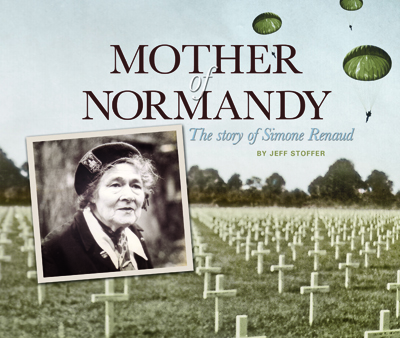
Stoffer wrote a coffee-table book and the script for “Mother of Normandy: The Story of Simone Renaud,” which had its debut at the GI Film Festival in Washington, D.C., last May.  The book and film chronicle the life of a little-known French woman who survived the earliest hours of D-Day and spent more than 40 years corresponding with families of fallen U.S. troops, as well as veterans.  She also helped establish an annual D-Day anniversary commemoration draws hundreds of thousands of visitors to Normandy each year.

Maurice Renaud, the son of Simone Renaud, who was a toddler on June 6, 1944, will also attend. Maurice Renaud is now a retired businessman who has coordinated return visits to Normandy by U.S. veterans every year for all of his adult life.  The battle at Ste. Mere-Eglise, where Renaud’s father was mayor, was depicted in the 1962 blockbuster Hollywood movie, The Longest Day.

In addition, Cathy Soref of Locust Valley, N.Y., will participate in the event. Soref will represent Operation Democracy, which gave birth to the Sister Cities program, pairing U.S. communities with war-torn counterparts in Europe after World War II.

Also scheduled to attend is Ken Olsen, a former reporter for newspapers in Moscow and Spokane, who wrote Lasting Valor, the 1997 biography of Medal of Honor recipient Vernon Baker of northern Idaho, who died in 2010. Lasting Valor was the basis of the 2006 NBC documentary by the same name. Olsen, who now lives in Portland, is a frequent contributor to The American Legion Magazine.

Stoffer has been with the 2.4-million circulation American Legion Magazine since December 2000, for the last four years as its editor and director, managing a variety of print and electronic media programs for the nation’s largest veterans service organization.

Books and DVDs will be available for signing by the author. Copies may be reserved at And Books Too!, 918 6th Street in Clarkston. The event is co-sponsored by American Legion Post 246 and VFW Post 1443 and Auxiliary, both in Clarkston.

Posted in Uncategorized | Tagged , , , , , , , , | 2 Comments

Returning veterans frustrated by high unemployment, hollow slogans, difficult access to federal jobs

By Ken Olsen

(Copyright 2010, All Rights Reserved)

Ron Conley approached VA representatives about an employment fair scheduled in Pittsburgh in November and asked if they would be taking applications for VA jobs at the event. The answer was a perplexing “no.”

“They told me that would be an injustice to veterans because they don’t have their completed applications with them,” says Conley, a past national commander of The American Legion and manager of the Allegheny County, Pa., Veterans Affairs Office. “They want to sit there and preach how good veterans are for employers, but they don’t want to take applications from veterans.”

This sort of hurdle is common for returning servicemembers, who find great frustration in their searches for government jobs despite a veterans-preference hiring law dating to the mid-1940s, a slew of “hire vets” slogans, and promises from politicians and agency chiefs. A government hiring guide acknowledges the complexity of a federal job search, then blames the problem on fairness rules. The Obama administration has even convened a task force to try to revamp the process.

Meanwhile, more than 21 percent of veterans ages 18 to 24 were unemployed in 2009, outpacing the civilian jobless rate. The official statistics likely underestimate the problem, because a large number of returning servicemembers don’t file for unemployment but stay with family or friends and live off their savings while they search for work.

“I think it’s far worse than folks see,” says Operation Iraqi Freedom veteran Tim Embree, a Legionnaire and a legislative associate with Iraq and Afghanistan Veterans of America (IAVA). “And I think with this wave of veterans coming home from Iraq – and potentially from a drawdown in Afghanistan – the problem is going to be worse than anyone can imagine.”

Urban Myth

Veterans are surprised at how difficult it is to land a job once they leave the military. Tom Tarantino and his fellow soldiers talked optimistically about the opportunities that awaited them once they finished their tour with the 11th Armored Cavalry Regiment in Iraq in 2005 and 2006. That vaporized when Tarantino left the Army a year later.

“It’s an urban myth that if you have been in the military, it’s really easy to get a job,” says Tarantino, also a Legionnaire and a senior legislative associate for IAVA. “I spent a very painful 10 months looking for work. Usually, I would get to the offer stage, and they would go with someone who had no military experience but had a master’s degree, or had been in the company a long time.”

He realized he was in trouble when a prospective employer, who was looking for a small-factory manager, cautioned him that he would have to oversee 30 people. Tarantino commanded 50 soldiers in combat as a platoon leader and 400 soldiers as acting company commander.

“At first I thought it was funny,” Tarantino says. “Then I realized I was in trouble. I had been sitting there talking to the guy for 20 minutes – going over my résumé, explaining what I had done. It was like teaching French to a guy from Mars.”

The federal government, on the other hand, is compelled by law to offer veterans an easier path to post-military employment. The government has more than 400 occupational specialties, the most of any U.S. employer. And VA is one of the largest veteran employers.

“Veterans prefer to stay with the government,” says Joe Sharpe, director of The American Legion’s Economic Division. “The jobs are often similar to what they had in the military. The benefits are good, the work is stable, and they feel that is a better fit for their family.” After nine years of fighting two wars and serving numerous combat deployments, military families need such stability, Sharpe says.

Returning servicemembers, however, are discouraged by a byzantine federal-application process, and never reach the interview stage. One of the most formidable hurdles, they say, is the website USAJobs.gov, the mandatory entry point for seeking federal work. The job descriptions posted there are voluminous. A maintenance mechanic’s job at the Pentagon fills six pages. The computerized application itself is long and complex. Veterans also have to fill out other forms and supply additional documentation to claim a veterans-preference status that they suspect is overlooked or ignored.

“It’s needless and bureaucratic,” Tarantino says. “You had to have eight hours to spend filling out an application. And you knew you wouldn’t get a call back.”

Barry Searle, a retired Army colonel and infantry combat veteran with a master’s degree and a decade of experience as a pharmaceutical sales and marketing director, applied for more than 70 positions through USAJobs.gov between 2007 and 2009. He couldn’t even land an interview for front-desk security guard at an Army maintenance facility, says Searle, director of the Legion’s National Security & Foreign Relations Division.

It’s a jarring welcome home for Iraq and Afghanistan veterans, who have a higher unemployment rate than any other veteran group. “A lot of these men and women come back and see this process and think it’s insane,” says Embree, who served with the Marines in Iraq. “And they are right.”

Once Burned

The federal hiring gauntlet is equally depressing for veterans who left the service before 9/11. Allen Dinning was medically discharged from the Air Force because of a knee problem in 1986. The disabled veteran became a respiratory therapist 14 years ago, after trying his hand at other careers.

“My dream job would be to work at VA with my fellow veterans,” Dinning says. He applied at a Pennsylvania VA hospital four years ago. Although Dinning had a decade of experience, VA passed him over but hired four co-workers from the hospital where he worked. None had served in the military. A VA human-resources recruiter told him there is no veterans preference for health-care workers, he says.

Now 47 and unemployed, Dinning has applied for six different VA positions, including clerical jobs, “just to get my foot in the door. I’m at the point where I’m going to apply for housekeeping.”

Kent Weaver left the Navy in 1995 after a 10-year career, to spend more time with his only child. He put on a suit and tie and visited the state employment office in Columbia, S.C., expecting to get help with his résumé and leads on good jobs. Instead, the employment representative told him he didn’t qualify for any veterans programs, handed him a business card for the West Columbia Police Department and told him to go be a cop. He received a similar brush off from the local VA.

“Being in the Navy didn’t mean anything,” Weaver says. “I was so mad I threw the card away and swore I would never go into a government office looking for help again.”

Weaver delivered windshields for $7 an hour, then worked as a corrections officer, a landscaper and a beverage-truck driver. He shattered his elbow working in a lumberyard four years ago and has been unemployed since. Weaver and his wife moved home to Pennsylvania, where he ventured back into a state employment office in desperation. The veterans representative he’s dealing with now is going out of his way to help, Weaver says. It’s help he could have used 15 years ago.

“I could have gone to work for the federal government when I got out if I hadn’t been lied to by the South Carolina Job Service representative that day,” Weaver says.

Iraq and Afghanistan veterans are running into similar obstacles with USAJobs. “It’s like, ‘I’m over here fighting for you and you send me to a website that’s going to take me forever to figure out?’” Weaver says.

The online application process is only part of the problem. There’s confusion as to whether applicants have to include “Key Skills Assessments” – a written summary of their knowledge, skills and abilities. Weaver, who recently used USAJobs to apply for a job, received a tip from VA that he needed to include that information. “But there was nothing on USAJobs that told me I had to do that.”

It also takes six to eight months for the federal government to hire someone after it receives an application. By that time, “most veterans have taken another job,” Sharpe says.

Veterans who have had mental-health counseling are deterred by security clearance requirements for federal positions in the Department of Defense, says Rachel Natelson, a volunteer legal adviser with the Service Women’s Action Network (SWAN).

“One issue that arises: ‘Have you ever sought mental-health counseling?’” Natelson says. Rule changes in recent years mean servicemembers who have received counseling because of combat trauma don’t have to report it. However, those who received counseling because of sexual harassment or sexual assault do have to report assistance they received.

“A lot of women are so afraid of the consequences of having counseling they don’t seek counseling or they don’t bother applying for federal jobs,” Natelson says. “And this doesn’t apply exclusively to women veterans.”

SWAN supports efforts to persuade DoD to stop requiring veterans to disclose counseling for sexual assault or sexual harassment. Meanwhile, women veterans there are floundering in the job market because VA counseling and treatment that would help them re-integrate is often difficult to obtain or geared for male veterans, Natelson says.

“Unemployment among veterans hasn’t been tied to the economic downturn alone. It’s tied to larger social issues, things like benefits and counseling,” Natelson says. “This will be a bigger and bigger problem as more and more veterans come back.”

All the hurdles don’t make for a better federal work force. A study released in August by the Partnership for Public Service and a private human-resources consulting company found that the federal government is doing a poor job of evaluating job applicants. The study singled out factors such as flawed computer systems that stymie a federal agency’s ability to evaluate applicants. Other factors included poor coordination among hiring managers, human resource offices, agency chiefs and the Office of Personnel Management (OPM).

Wired to Serve

The unemployment issue has captured the attention of Adm. Mike Mullen, chairman of the Joint Chiefs of Staff. “We’ve got over a million who are returning from these wars and whose American dream hasn’t changed a bit,” Mullen said in a speech to the Executive Club in Chicago in August. “They are flat-out wired to contribute, flat-out wired to serve.”

The consequences of not dealing with the needs of returning servicemembers, he added, are already appearing. “We are generating homeless at a rate about four times greater than we did in Vietnam.”

There are signs the federal government is addressing the problem. Last year, President Obama directed his agency chiefs to do a better job of hiring qualified veterans, and many have responded with initiatives to remove some of the hurdles.

Assistant Labor Secretary Ray Jefferson is drawing praise for his efforts to revamp the federal hiring process. OPM, meanwhile, persuaded seven federal agencies to reserve 600 jobs for qualified veteran applicants in advance of a job and hiring fair at The American Legion’s 92nd National Convention in Milwaukee earlier this year.

Job descriptions were distributed to veterans across the country through the Department of Labor, state employment agencies and veterans service organizations such as the Legion two weeks prior to the convention, to give veterans time to apply.

Nearly 170 veterans met with U.S. Customs and Border Protection officials at the convention, says Joe Arata, assistant director for national recruitment at the agency.

“We’ve greatly expanded our reach beyond what you would consider traditional veterans hiring,” Arata says. As a result, 22 percent of new applicants for Border Protection jobs are veterans. And 31 percent of new hires in fiscal 2010 are  veterans.

OPM also sent a trainer to the Legion’s convention workshops to help veterans submit polished applications for federal jobs, and has a task force working to improve USAJobs.gov. Sharpe credits the Obama administration and John Barry, director of OPM, for starting to make these strides.

“They are making good on their promise,” Sharpe says. “I’ve never seen anything like it.”

There’s far more than jobs at stake, Embree adds. “We’re at a crossroads,” he says. “If you get veterans back into the economy, you are going to solve a lot of the problems you are going to see down the road, such as homelessness and suicides. The time for talk is over. This administration and this Congress need to step up and show today’s veterans they have their back.”

This story appears in the December issue of The American Legion Magazine

Posted in Uncategorized | 1 Comment

Family considers leaving military after enduring multiple combat deployments

By Ken Olsen

(Copyright 2010, All Rights Reserved)

Josh Buck read his daughter a bedtime story on the eve of his second deployment. He tucked her in and gave her the news. “Daddy has to go back to work tomorrow,” he said. Little Reagan leapt up and closed the bedroom door. “No,” she told her father. “You stay here.”

That moment in August 2009 illustrates the conundrum the Bucks and other families face when they weigh whether or not to stick with the multiple deployments that now define a military career, or get out and try for a more stable life, albeit in a sour economy.

“I think this deployment is harder,” says Josh’s wife, Deanna. “He is missing her 2-to-3 year. And we are at the potty-training age. So I don’t get a break.”

Josh missed his daughter learning to count to 10, speak in sentences and ride a tricycle. Moreover, the family worried Reagan wouldn’t take to her father when he came home on R&R in late March. She did, Deanna says. “She was so sad for the longest time after he left again.”

Now, even before he’s returned home from his second deployment, Josh has learned he is already scheduled for a third combat tour in August 2011. That’s if he stays in the Army. “If he goes, it means he will miss her 4-to-5 year, and she will be starting school,” Deanna says. “Do we want to one day know what it’s like to live a real life?”

The Bucks, who were high-school sweethearts, did not expect to find themselves questioning an Army career. He is a combat medic whose sister married one of the men he served with in the 82nd Airborne Division. Deanna’s brother is an Army Ranger.

Josh’s first deployment lasted 15 months. He made it home on R&R four days before Reagan was born. When his tour was finished, his daughter was already 7 months old.

“Kids change everything,” Deanna says. “It’s really, really hard for me because I get to the point I count down the days and the weeks. I feel like my life is on pause, waiting for somebody to hit play.”

Deanna is surprised to find she doesn’t get support from the places she expects it. Some other Army wives criticized her after she posted a note on Facebook about how sad she was that Josh had returned to Afghanistan. “They said they ‘hate all of these Army wives who whine – it’s only a deployment.’ That’s easy to say if your husband is stateside. I’m sorry – I love my husband a lot. I don’t want to send him off to war.”

The family’s personal security is a great concern while Josh is deployed. “I felt some real serious anxiety when he went back to Afghanistan. I have an alarm system. I have a dog. I have guns. (And) I have this horrible thing where I can’t sleep when he’s gone. When he’s home, it’s like a great weight is lifted off me.”

There’s also the grind of keeping up a house. The air conditioner broke in April, just as spring temperatures headed for the 90s. Deanna waited more than a week for a repairman to check it out, only to learn it would take another week to get the parts necessary to get it running again. Deanna loaded her 2-year-old in the car and drove 250 miles to her brother’s house in Savannah, Ga. The garage door broke the morning she planned to leave.

“Everything always goes to crap when the husband is gone,” she says.

The couple thought Josh would have at least two years at home after his current deployment ends this fall, one reason they bought a new house. If they don’t leave the Army, the Bucks not only face the prospect of spending every other year apart, but also of moving to different posts every two to three years, or even overseas. Reagan would never stay in the same school for long. If they leave the Army and sell their house to move home to Texas, they will have to repay the $8,000 first-time-homebuyer’s tax credit. They also worry about Josh’s ability to find a job, given the recession.

“I hate how everybody thinks that you can’t survive in the civilian world,” Deanna says of pressure she feels from the Army to stay. “My parents do it. Lots of people do it.”

Deanna also knows Josh feels he needs to do more for his country. “He told me if he does get out, he will always feel like he needs to be there until the war is over.”

Although she says she would never tell him to quit, if it were up to her, they would put the Army life behind them:  “Eight years is enough to sacrifice.”

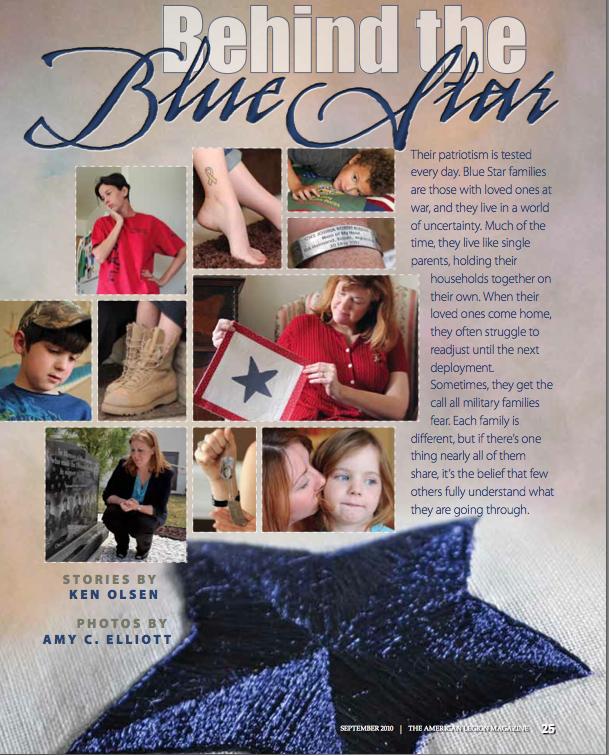
Deanna Buck’s story is part of the special report “Behind the Blue Star” about how military families are faring after nine years of war. The special report, written by Ken Olsen, was  featured in the September 2010 issue of The American Legion Magazine).

Posted in Uncategorized | Leave a comment

Tireless warrior: Kristy Kaufmann fights for military families

By Ken Olsen

(Copyright 2010, All Rights Reserved)

For more than three years, Kristy Kaufmann has been one of the most prominent voices warning that too many of the nation’s military families are quietly crumbling. The wife of a battalion commander who served in Iraq, she made her case at an invitation-only gathering between commanders, spouses and a four-star general. She delivered her message to a Cato Institute forum titled “Can the Pentagon Be Fixed?” She penned an op-ed for The Washington Post about the invisible casualties of the global war on terrorism – the families – quoting a spouse who summed it up this way: “You don’t have to be a soldier to be wounded by these wars, but no one outside of (military families) seems to know this.”

Today, despite thousands of positive responses, invitations from the White House, the creation of a Congressional Military Family Caucus and a plethora of new programs, conditions for military families continue to deteriorate, Kaufmann says.

“It hasn’t been a lack of effort, at least in the last couple of years,” she says. “It’s a lack of effective effort. I think the top level of the Army has embraced it. There hasn’t been much buy-in below that – not because post and unit leadership don’t like families, but because they are under-resourced, undertrained and don’t have sufficient incentive. I’m an optimist, and I believe in the system, but I am very, very frustrated. We still haven’t shaken things up in a way that makes a significant difference for families.”

Doing that, she contends, will require rewriting the laws and regulations that restrict groups like The American Legion and the American Legion Auxiliary from directly helping military family-readiness units. It will require permanent, dedicated social-work and mental-health staff at the unit level. It will require a military that holds commanders and noncommissioned officers accountable for how families are faring, and gives them the resources to support those families.

“This is not just a moral imperative, it is a national-security issue,” Kaufmann says. “If you have a broken family, you will have a broken soldier, and since less than 1 percent of the population is fighting these wars, that poses a very real problem. And we’re not even talking about the impact this will have on our country as a whole in the coming years.”

A former gymnast at the University of California, Berkeley, Kaufmann met her husband, a West Point graduate, on an impulse trip to Las Vegas. Two years later, she sold her personal-training business and became a family-support group volunteer in Fort Sill, Okla. She continued that work when her husband transferred to Fort Bragg, N.C., getting what she calls “the ground’s-eye” view of life for military families. She also became increasingly frustrated.

“I tried all of the right ways at Fort Bragg,” she says. When that failed, she started making her case more publicly: writing the Post op-ed, speaking at The American Legion’s national convention in 2009, and meeting with top Army officials.

Kaufmann praises those who have acted, including Defense Secretary Robert Gates, Army Vice Chief of Staff Gen. Pete Chiarelli, and Adm. Mike Mullen’s wife, Deborah, who has spoken openly about the problem of suicides among military spouses. She credits the Army for family programs such as Strong Bonds, a relationship-building retreat. The list of all that remains undone, however, is far too long, she says.

The primary tool for supporting the families of deployed soldiers, volunteer-operated family-readiness groups, “are the Army’s only unfunded mandate,” Kaufmann says.

The Army has recently responded by creating paid administrative-assistant positions for FRGs, a job whose pay fails to attract the social-work and mental-health professional skills that are desperately needed, she says.

“It’s not that the programs aren’t there on paper. The problem is in the implementation. Too often they don’t work or families don’t understand how to access or navigate them.

Kaufmann is now drafting a list of recommendations at Chiarelli’s request. She’s also struck by what this means about where things stand.

“While I’m honored to have been asked by the vice chief of staff to provide specific recommendations on how we can more holistically integrate family support throughout the Army, I think it’s emblematic of the situation, that after nine years of war, this task – at least in part – has fallen to a volunteer,” Kaufmann says. “Unless we harness everybody in this, we will lose a generation of our servicemembers and our families. I would think after our Vietnam experience, we’re smart enough not to do that.”

Kristy Kaufmann’s story is part of the special report “Behind the Blue Star” about how military families are faring after nine years of war. The special report, written by Ken Olsen, was  featured in the September 2010 issue of The American Legion Magazine).

Posted in Uncategorized | Tagged , , , , , , , | 3 Comments

Fort Hood shootings leave lasting effect on Army wife, mother

By Ken Olsen

(Copyright 2010/All Rights Reserved)

Angi Cunningham didn’t believe her husband’s friend when he called Nov. 5 to warn that a gunman had opened fire on his fellow soldiers at Fort Hood, Texas. “He said, ‘There’s been a shooting. Get inside.’ I thought he was joking.”

She had just returned home after picking up her son from a half day of school. After one look at the TV news, Angi and her husband, who happened to be home, gathered the children and retreated to the upstairs master bedroom, hoping they were out of the line of fire. They put mattresses over the window as rumors spread that the shooter was in Comanche 3, the family’s housing development on post. They got a call from the worried parents of a child they were baby-sitting.

Angi’s fear spiked. “I’m getting told they are shooting in the village where I’m living,” she recalls, her voice echoing the disbelief she felt at the time.

They heard there were four shooters. Then the news erroneously reported that the gunman had gone to a theater. “The misinformation was rampant.”

Soldiers from her husband’s unit called continuously, looking for reassurance. “Can you see my wife’s car?” one asked. “I heard the shooting was at the PX, and I know she was going shopping today.”

Cell-phone service was severed, and all they could do was watch the news, wait and worry.

The stress didn’t ease after police critically wounded and apprehended the alleged shooter, Maj. Nidal Hasan. Angi spotted a couple of soldiers as she neared the entrance to her son’s school the next day and panicked: “It really freaks you out to find out it was one of your own.”

She began to worry about any stranger in uniform. She was outraged at the news that Hasan’s supervisors at Walter Reed Army Medical Center were concerned about his behavior but allowed him to move to Fort Hood anyway, and that the DoD had intercepted some of Hasan’s disturbing e-mails but hadn’t taken action.

“That almost made me more upset,” she says. “They should have watched him more closely.”

The family had moved into base housing from a rental in nearby Killeen to be safer during her husband’s deployment. Long after the incident, that irony remains unsettling to the 25-year-old mother. “It still creeps up on me. Anybody anywhere could snap.”

This isn’t what she envisioned when she agreed to follow her husband wherever his military career led. He switched from the National Guard to the Army in January 2007 after construction work in Ohio evaporated. He told Angi they had the choice of living in Kansas or Texas, but he thought, “Texas would be more fun.” She was up for anything. They threw their belongings in the back of their Ford pickup, scrunched together in the front seat and headed south.

“That was probably one of our least thought-out plans,” she says with a laugh.

Angi grew up in a Marine Corps family and remembers sitting on a box eating TV dinners during the course of her father’s frequent transfers. She only vaguely remembers his deployments, beyond his homecoming from Desert Storm on her seventh birthday. She doesn’t recall any of it being difficult, a credit to her mother.

Moving to Killeen was both an adventure and a challenge. Not knowing what to expect and not knowing the seasons, Angi was surprised to learn that winter in central Texas lasts a month and “a quarter-inch of snow is a once-in-a-lifetime blizzard.”  She was shocked to see the first power bill once they turned on their air conditioning, and she was discouraged to learn just how far she was from family.

One Christmas while her husband was deployed, Angi made a 14-hour drive to St. Louis with her 1-year-old daughter and 3-year-old son so they could spend the holidays with her father; they then drove another 10 hours to West Virginia to visit her mother and in-laws. “I came back so stressed out the doctor had to put me on Valium for a week,” Angi says. That was the last big road trip.

When her cousin died in a boating accident the following April, she loaded the car again and prepared to head to West Virginia for the funeral. “I wrestled with myself all night about going,” Angi says. “One of the hardest moments was admitting I couldn’t do the 24-hour drive.” That left her alone with her grief and the guilt of not going to the funeral of one of her closet childhood friends.

Angi also worked hard to plug in with the military community at Fort Hood. She volunteered to make telephone calls to half of the 260 families in her unit’s family-readiness group, and made sure every soldier had a warm welcome home from deployment, even if family couldn’t be there. She helped a mother who was harassed by her deployed son’s bill collectors and wives who had not heard from their husbands. She told reluctant families where to get assistance. “A lot of people are afraid something will happen if the Army finds out they asked for help,” she says.

She leaned on her mother, who had been through it before. “I love my mother – she’s a bucket of knowledge,” Angi says. “She talks me out of my stupid ideas,” such as the temptation to give her husband’s commander what-for after a surprise training trip to the field meant the supper she cooked was for naught.

She prepared her son, daughter and stepson to move again. They transferred to Fort Drum, N.Y., last spring. It was a relief to leave Fort Hood for a smaller base in a landscape that feels more like home to her family, although she can’t entirely escape. A gas-station attendant in upstate New York, who thought Hasan had died, asked if things were back to normal at Fort Hood. “There hasn’t been much of a public update on the situation, which has led a lot of people to almost forget the event ever happened,” Angi says.

“Part of me wants to yell, ‘Hey, what about us?’ But then the other part of me realizes most of the country was not affected by this tragedy.”

Angi wants to move on, too. “I have decided I cannot live in fear of a repeat of what happened on Fort Hood,” she says. “Granted, some days it’s easier to say that than to feel it. But I give every place and person the benefit of the doubt unless shown otherwise.”

Angi Cunningham’s story is part of the special report “Behind the Blue Star” about how military families are faring after nine years of war. The special report, written by Ken Olsen, was  featured in the September 2010 issue of The American Legion Magazine).

Posted in Uncategorized | Tagged , , , , , , , | Leave a comment

From Blue Star to Gold: For military spouses and families, death changes everything

Part III

Quickly forgotten, families of the fallen struggle with loss, loneliness

By Ken Olsen

(Copyright 2010, All Rights Reserved)

Shellie Smith buried her husband near Clayton, N.C. Army 1st Lt. Justin Smith could have been laid to rest at Arlington National Cemetery, but he always said sweet tea and Southern food were the best. “So I buried him in the South, near me and the boys,” says Shellie, whose husband was killed by a suicide car bomber in Iraq. “I like it where I can go have a picnic with him if I want to.”

That’s where the poetry ends for Shellie, one of thousands of women who have heard the knock on the door that plunged them into the world of widowhood, single parenting, the military bureaucracy they feel neither wants them nor knows how to deal with them, and a nation that too quickly forgets the surviving families. They find solace in each other, but old friendships fracture and fade.

“You realize this is as good as it gets,” Shellie says. “I almost think that’s the hardest.”

Shellie got word of her husband’s death the night of her oldest son’s birthday. She was exhausted, sleeping on the living-room couch after putting her youngest son, then an infant, down for the night. Unable to rouse her, the military detail went to the apartment next door and woke Shellie’s grandmother, who was a week past heart surgery. Her grandmother made the men wait while she called the lieutenant’s parents. And then they were back, “bamming at my door,” Shellie says.

She peeked out the window, saw a man in a military-style coat and said, “No way.” She checked his car to see if it had government license plates. She looked back at her porch and saw a second man with a Bible in his hand. She tried to remain calm. She opened the door, made eye contact, and asked for a minute. She called her parents twice, angry that they didn’t answer. She reached her aunt, who said, “I’m on my way.” She went back to the living room, suddenly aware of her mismatched T-shirt and pants, and covered herself with a blanket.

These are things she remembers.

“How?” she asked, flatly.

“We think an IED.”

“Are you sure?”

Shellie held herself together until her aunt fetched her infant son and placed him in her lap. Seeing Justin’s features in his face brought tears.

“I was apologizing to them for crying,” Shellie says.

Her father arrived, also in tears, and asked, “Are you sure it’s the right Justin?”

The military detail left them brochures about grief.

Still in shock, Shellie sent 8-year-old Spensir to school the next morning without telling him. Her son from a previous marriage, Spensir considered Justin his father. He came home to a living room full of people and thought his mother had organized a surprise party for him. He went to the kitchen, surveyed his birthday cards, then looked at his mother and said, “My daddy’s dead, isn’t he? I told you he wouldn’t come back.”

“That was the worst,” Shellie says. “Telling my child.”

“A Feeling”

Shellie is surprised she even met Justin. She didn’t go to dance clubs, yet found herself at the High Five in downtown Raleigh, N.C., with a friend one night in August 2003, where she saw a tall, handsome man working magic on the dance floor. She couldn’t help but join him. “I’m a white Baptist girl,” she says, laughing. “We don’t dance. Our hips don’t move that way.”

By the end of the evening, Shellie had given Justin her telephone number – also out of character for her. “I had a feeling,” she says.

After Justin died, she ran into a man who had been with him at the club. “He said, ‘Are you that girl Justin met at the High Five that night?’ We all told him he was crazy. And he told us, ‘I have a feeling about that woman.’”

Headstrong and charming, Justin was earning his bachelor’s degree, and he owed the Army another eight years after he graduated. Shellie decided the military life was worth it. He returned to active duty a few months after they married, and in October 2004, Ayden was born. Justin carried his son’s picture to the war zone the following spring and showed it to everyone. “He would walk up to the regimental commander and say, ‘Colonel, do you want to see something to make you smile?’ And he would show him Ayden’s picture,” Shellie says.

Three weeks before he was supposed to come home on R&R, Justin and his men were running a checkpoint on the outskirts of Baghdad. They stopped a car. Justin approached it, glanced inside and started to back away. The car exploded, killing Justin, his Iraqi interpreter and three other soldiers.

“He was 225 pounds, muscular, 6-foot tall,” Shellie says. “I can see him in full battle rattle, out there sweating in the heat, and the next thing he knows he’s standing in heaven saying, ‘Whoa, dude.’”

The Scarlet W

Fallen soldiers’ wives find their identities abruptly changed. They are no longer Ann, Casey or Shellie. Or Dan’s, Joshua’s or Justin’s wife. They are widows.

“There was this feeling that my only identity was being a widow,” says Ann Scheibner, whose husband was killed during his last combat mission in Iraq. “I couldn’t run into anybody where that isn’t what it was about.”

Casey Rodgers’ journey into this upside-down world began at her husband’s funeral when a well-wisher gave her a book about being a widow. “Why would you give somebody something with ‘widow’ on it at a funeral?” Casey says, pacing the living-room floor of her home near Sanford, N.C., where a high‑ceilinged wall is covered with photos of her late husband and their family. “Treat me like you would if I was still Casey Rodgers with my husband.”

Joshua Rodgers died when the helicopter he was piloting was shot down in Afghanistan in May 2007. After the funeral, Casey quit receiving invitations from her social circle. She was dropped from friends’ e-mail chains. People became uncomfortable when she mentioned her late husband’s name. “You can’t be a widow in front of other people,” she says.

She was surprised to find her presence threatening to some married women. She quit wearing high heels to church. She learned to speak to the woman first when approached by a couple. The cheap suspicion is insulting. “Don’t assume I want your husband just because I don’t have one,” she says. “Get to know me like you would get to know somebody else.”

Casey finds even her relationship with the military awkward and strained, a surprising discovery she made when she went to greet her late husband’s unit after its return from Afghanistan in early 2008. “I knew it was important to them to know I was still standing, because if families were destroyed by it, how were they going to be able to go back over there and do their job?” Casey says. Commanders avoided her and sent “a poor old captain over to ask how I was doing. Even the Army doesn’t know how to deal with widows.”

She avoids telling strangers she’s a widow. “Everything stops, everything changes, when they find out,” Casey says. “Half the time, they just up and walk away. If they think it’s hard for them, what do they think it’s like for me?”

This is called the “Scarlet W” in military circles, says journalist and Army wife Rebekah Sanderlin. “One of my friends tells me if she goes somewhere there’s not a military base and tells somebody her husband was killed in Iraq, she’s kind of a freak show,” Sanderlin says.

Some military spouses are uncomfortable around widows. “They think it’s some sort of jinx,” Sanderlin says. “A lot of wives will not watch the news. If you’re in the ignorance-is-bliss group and you’re sitting across from a widow, you can’t really deny it. I don’t think they want to shun the widows, it’s just the discomfort.”

Families of the Fallen

People who work with families of fallen soldiers say this awkwardness and alienation is common not only for widows but also for the parents and siblings of those killed in war.

“There is this initial crush where the family is often deluged with gifts of food and flowers,” says Ami Neiberger-Miller, public-relations officer for the Transition Assistance Program for Survivors (TAPS). “The funeral happens, and all of that goes away. People think, maybe we shouldn’t invite this widow or that family to our Christmas party because they’re still sad.”

She still hasn’t reconnected with the longtime friends she was vacationing with in 2007 when she learned her brother Chris – a soldier on his first deployment – had been killed by a roadside bomb in Baghdad.

People are also uncomfortable when widows and other survivors talk about the loved ones they’ve lost. “Unfortunately, society interprets us wanting to talk about our loved ones as, ‘we haven’t moved on,’ ‘we’re grieving too much,’ ‘we’ve been grieving too long’ or ‘we’re grieving in the wrong way,’” Neiberger-Miller says. “They tell us we need to see a doctor.”

Survivors, however, “don’t think grief is a mental illness. We think grief is the price you pay for losing someone.”

Families report mixed experiences with their casualty-assistance officers, and the military in general, in the wake of a loved one’s death. Part of the issue is the grueling process of doing all the military requires to make sure a servicemember’s remains are properly laid to rest and benefits started.

“The widow is suddenly put in a position to make a lot of decisions that are pretty jarring at a point where she is least equipped to deal with them,” says Neiberger-Miller, who contacted TAPS as she tried to deal with her brother’s death and later went to work for the nonprofit survivor-advocacy group.

As for the reception widows receive from their husband’s military unit, “it depends upon the training and support they have. I’ve seen commanders do a great job at reaching out.”

One came to Arlington National Cemetery over Memorial Day to talk to a widow while Neiberger-Miller was there. Other units are less comfortable, and may not know how to react.

“I think the leadership sets the tone,” she says.

Through all of this, it’s important to consider how circumstances may be different for military families. “Their loved one often died in a violent way. As a result, our families are all traumatic survivors.”

Single Parenting

Handpainted silver letters on the front door of Shellie Smith’s home say: “Family, Friends, Faith, Freedom.”

Anger, bitterness, loneliness and incomprehension have also lived at this address. “I’ve been pretty pissed off about it,” Shellie says. “The fact that his life was cut short makes me angry. The fact that his little boys don’t have a dad makes me mad.”

She must also help her children understand their loss. Her youngest son would say, “‘Let me just see him.’ And I said, ‘He’s in heaven.’ And Ayden would say, ‘So why can’t I go to heaven and see him?’”

Ayden is now beginning to understand that his daddy is gone. Shellie worries about him starting school this fall with students whose fathers are there for soccer games and class performances. “I’m trying to explain what death means,” Shellie says. “And why it’s final.”

Then there is the daunting task of raising children without a father. Spensir told Shellie he won’t know how to use the grill because he doesn’t have a daddy. And she doesn’t have anyone to help her shoulder the load. “My little one was sick a lot with ear infections,” Shellie says of her single-parenting struggles. “And it would be helpful to have a husband when you are puking.”

Well-meaning people push her to start a new relationship, offering the pat advice that widows loathe: “You’ll find somebody else.” Or, “It’s been four years – it’s time for you to move on. You’re still young – you’ll meet someone else. There’s still time for you to have more kids.”

“Their heart’s in the right place, but their mouth isn’t,” Shellie says. “Right now, people are asking why I’m not dating. I tell them, ‘The line of men looking for widows with two boys is empty.’ In reality, I have no energy for that.”

Shellie and her widow friends have dissected the difficulties of dating. “Let’s say the new guy comes along,” Shellie says. “First he has to love me. Then he has to love children that aren’t his. Then he has to deal with the fact that I still love my husband. And he will have to deal with the fact that my husband was a hero.”

Instead, she is moving to a house across the road from her parents and grandparents so her father can teach the boys to hunt and fish, and “they can explore and rip and run, like boys love to do.”

A Son’s Journey

Ann Scheibner didn’t have a chance to tell her 12-year-old son about his father’s death. Tyler answered the door when the military detail came with the news. Dan was killed on his last combat mission, a patrol he volunteered to join to help the new platoon sergeant learn the dangerous terrain his unit patrolled in Iraq.

“With such an awful thing, my son came over and put his arms around me, and said, ‘We’re going to be OK, Mom,’” Ann says. “He was already taking on that role when his dad deployed.”

Ann had spoken to Dan that morning. He was done with combat missions. He was excited about his transfer to a less dangerous job at headquarters after his unit took heavy casualties. At the last minute, however, he took an Iraqi interpreter’s seat in the back of a Hummer and was the only one killed by a roadside bomb that exploded as the patrol returned to base.

For Ann, the first week after her husband’s death was particularly awful. Getting military IDs changed, signing paperwork, dealing with her casualty-assistance officer.

“There’s a lot of things that were so wrong and done so poorly,” says Ann, who had been helping the spouses of other soldiers in Dan’s unit deal with their husbands’ deaths just a month earlier. “A lot of times, I was telling my casualty-assistance officer things that needed to be done. In a lot of circumstances, I was trying to make him feel comfortable.”

She also worries about the way the door was slammed on her son’s grief. Tyler established a rapport with a child psychologist at Fort Lewis, Wash., and then arrived for an appointment one afternoon to find that the psychologist no longer worked there. The staff told Tyler he could start over with another counselor. He turned and told his mother they were leaving. “To this day, my son won’t talk to anybody” about his father’s death, Ann says.

“The kids are the ones who are forgotten,” Casey adds. “People say kids are resilient. Every day I worry about the girls. I have a widow friend whose 11-year-old is suicidal.”

Joshua was the kind of father who was out bouncing on the trampoline or splashing around a swimming pool with his daughters. His presence can’t be replaced. “He was just a big kid,” Casey says with a rare smile.

The Death Bureaucracy

If grief is not overwhelming enough, widows are awash in bureaucratic struggles from the moment they learn their spouse has been killed. Casey had to call for her senator’s help so she could accompany her husband’s body on a flight from Dover Air Force Base to his family’s home in Nevada after the military repeatedly rebuffed her request.

Ann said she had to fight for months to get the active-duty health-care benefits she was entitled to receive for three years after Dan’s death. She also learned she would only receive half of the military pension Dan could have drawn if he hadn’t gone to Iraq. That essential financial help is temporary. It expires when Tyler is 18 – or, if he goes to college, 21. Social Security stops when he is 16.

Most egregious, however, was Ann’s battle to have her husband cremated. Dan’s urn was engraved with the wrong date of death, and the government refused to change it because it matched his death certificate, which was also incorrect.

“It was terrible,” Ann says. “I was trying to go home to bury my husband. And it wasn’t my mistake. Every other piece of paper, every other award, his Purple Heart – all of them had a different date. If they had all been the same, I wouldn’t have liked it, but I would have been understanding.”

Ann finally called TAPS. The group got the date on the urn changed, but her frustration from the ordeal lingers. “That’s what spouses, who are overwhelmed, are battling with the military,” Ann says. “Our soldiers and our families deserve more than that.”

The personal hurdles are just as daunting. Shellie floundered for three years after Justin died, in part because she lives an hour and a half north of Fort Bragg, N.C., and the nearest community of military widows. “I didn’t know anybody else like me,” she says.

That changed 18 months ago, when Shellie met Casey and another widow at an event for children of fallen soldiers. She’s discovered a bond like no other. “When another widow says she understands, I know she means that,” Shellie says. “Widows have credentials. They have gotten the same knock. They have cried the same tears.”

Widows share fears and feelings, and form a close-knit surrogate family that will drop everything to drive 100 miles at midnight to be with another widow whose child needs emergency surgery – as was the case when Shellie’s son was injured in an accident last spring.

Like widows, children are more comfortable around other children who have lost their parents, Shellie says. “I’ve heard my kids say to other kids, ‘Is your daddy in heaven? My daddy’s in heaven too.’”

Ann lost that connection after she moved back to Michigan two years ago so her son could be close to her late husband’s family. “I felt like it was the best place for him to be grounded,” she says. Still, it’s a struggle for her after having the support of military communities for 17 years. “Some of the loss is moving away from it all.”

That’s the dilemma facing Casey as she prepares to move her daughters back west. Last summer, she realized that Madison, Autumn and Ashlyn were happier in Nevada, when they visited Carson City, where she and Joshua became high-school sweethearts.

“I have a support system here,” Casey says, referring to her widow friends in the Fayetteville area. “But when my kids went home last summer, they just lit up.”

Now she’s preparing to make her way in a civilian community that has largely forgotten the wars.

Remember and Respect

That disconnect is especially harsh when it comes to a soldier’s death. A week after Justin died, Shellie went shopping for a dress to wear to his funeral. She overheard two men in a mall food court having a loud antiwar discussion. She ran out of patience, walked over, and pulled out Justin’s dog tags and wedding ring, which on a chain around her neck.

“I told them, ‘My husband gave his life seven days ago so you could sit in this food court and express your opinion as loudly as you want to and as freely as you want to, without thinking twice. I want you to remember why.”

Remember. Respect. At the heart of it all, that’s the widows’ simple request.

Shellie has since run into similar situations – strangers asking questions until they find out she is a military widow. Then they quiz her about her feelings on the war and the president.

“I tell them, ‘His death was personal. His death was not political,’” Shellie says. “Whether you believe in the war or not, whether you support it or not, it’s happening. The people involved in fighting the war are real, and the families are real. My children are without a daddy – and I live without a husband – so they can live and do and say whatever they want without any fear.”

This is Part Three of a special report featured in the September 2010 issue of The American Legion Magazine).

Posted in Uncategorized | Tagged , , , , , , , | Leave a comment

Medal of Honor recipient Vernon Baker buried at Arlington

By Ken Olsen / For The Spokesman Review

(Copyright 2010, All Rights Reserved)

ARLINGTON, Va. – A caisson drawn by seven white horses carried Vernon J. Baker to his final resting place in Arlington National Cemetery Friday under the solemn watch of the 3rd Infantry Regiment Honor Guard – starched and sharp in full dress blues despite the stifling September sun.

Four soldiers from the nation’s oldest infantry regiment led the procession along Arlington’s narrow asphalt lanes, followed by the U.S. Army Band, 18-white gloved riflemen, the color guard and the flag-draped caisson. An eight-man casket team, a lone Medal of Honor flag bearer and three Vietnam Medal of Honor recipients came next. Widow Heidy Baker, escorted by Medal of Honor recipient Tom Norris and Maj. Gen. Reuben Jones, brought up the rear with a long line of mourners that included Paul Dickerson, who served with Baker in northern Italy in World War II.

They filed to Baker’s gravesite, located at the edge of a sea of white markers that stretched into trees already taking on autumn colors. A chaplain’s words spilled onto a breeze that brought minimal relief from the record-breaking 98-degree heat. A seven-man firing party snapped off three sharp rounds. Taps cried goodbye. Handkerchiefs wiped away tears and wiped brows.

Norris, retired Gen. Robert Foley, Brian Thacker, Joe Marm and Barney Barnum – all who earned the Medal of Honor in Vietnam – came forward one-by-one at the end of the ceremony to lay a yellow, long-stemmed rose beside Baker’s urn, then stepped back and saluted a hero’s farewell.

Baker, who lived near St. Maries, Idaho, was the only living black World War II veteran to receive the Medal of Honor, the nation’s highest commendation for battlefield valor. That recognition, delayed by the racism of the era, came 52 years after Baker led a suicidal assault that helped the Allies breach the Gothic Line and drive the German Army out of northern Italy. His white commander deserted him and his men during that April 1945 battle.

Baker’s widow cried quietly throughout the memorial, like many others gathered here, far from ready for this final moment, far from ready to say goodbye to the humble orphan from Wyoming who emerged with remarkable dignity and grace from some of the worst that 20th century America dealt to black soldiers.

The contingent at the memorial included Lt. Col. Mark Jackson, who, as a captain, escorted Baker to the White House in 1997 where he received the Medal of Honor from President Bill Clinton. Gen. Colleen McGuire, provost marshal general of the Army, U.S. Rep. Walt Minnick, D-Idaho, and other dignitaries also came to pay their respects.

Baker’s stepdaughter, Alexandra Pawlik, and step-grandson Vernon Pawlik, were on hand as was Kathleen Jackman, a neighbor of the Bakers in Idaho’s Benewah Valley; she also attended the White House ceremony 13 years ago.

Baker attended the reburial of the only other black World War II Medal of Honor recipient buried at Arlington – Sgt. Edward A. Carter – on a frigid day in January 1997, less than 24 hours after the White House ceremony.

Baker would been uncomfortable with this attention, all the while proud of the recognition it brought to the forgotten black soldiers who fought in the last officially segregated combat units of the U.S. Army. He always took little credit for his deeds, insisting he was just a soldier trying to do his job.

“The real heroes were the 19 men I left on the hill that day,” Baker said repeatedly, referring to the men from his unit killed during that brutal but decisive battle.

That will inspire soldiers and citizens long after this day fades. “He’s an example worth following,” Norris said as today’s memorial concluded. “He was such a low-key, unassuming man with incredible insight and wisdom. I was incredibly lucky I was able to know him.”

Ken Olsen is author of Lasting Valor, the biography of Vernon Baker and the basis for the NBC documentary, also called Lasting Valor.

http://www.spokesman.com/stories/2010/sep/24/medal-honor-recipient-baker-buried-arlington/

Posted in Uncategorized | Tagged , , , , | 2 Comments

Forgotten on the Home Front: Guard and Reserve Families Serve in Isolation

PART II

‘A lot for a country to ask’

Far from the active-duty community, Guard and reserve families feel isolated

By Ken Olsen

(Copyright 2010/All rights reserved)

Stacy Bannerman ate her holiday meals at a local diner during her husband’s last National Guard deployment. She left an empty place setting across from her as families crowded the tables around her.

As lonely as she felt, that’s more routine than remarkable for Bannerman and other National Guard and reserve families. Unlike their active-duty counterparts in the war on terrorism, most Guardsmen and reservists don’t live near military bases, have a community of friends who share their experience, or have access to the family support and mental-health programs introduced on military bases in the past decade. Scattered across rural areas or blended into big cities, National Guard and Reserve families are also largely invisible to civilians.

“I cannot overemphasize the sense of social isolation,” says Bannerman, whose husband was first deployed shortly after they moved to Kent, Wash., in early 2004. “There was nobody else in my situation. It was a difficult, lonesome time – one I hadn’t anticipated and one I didn’t have any support for.”

Families feel this isolation in communities as small as Hayward, Wis., where Crystal Gordon knows just one other National Guard wife with a husband in the war zone. “I don’t think the community even knows there’s a unit from here that’s serving in Iraq,” Gordon says.

The isolation is equally prevalent in major metropolitan areas like Phoenix, where Virginia Lynch awaited the return of her husband’s Guard detachment from its second tour.

“We don’t have that really tight-knit community, and our lives aren’t geared around the military,” Lynch says. “The hardest thing is the loneliness.”

Even active-duty families point out the disparities. “National Guard and reserve don’t have the support the families of active-duty soldiers do, and active-duty families are having a hard time,” says Christina Piper, a veteran, Army wife and co-founder of the blog site “Her War, Her Voice.”

Surprise Mobilization

Guard and reserve families struggled the first time their loved ones were summoned to Iraq and Afghanistan. They expected their citizen-soldiers to drill one weekend a month and two weeks a year, and respond to periodic natural disasters. Instead, they became full-time combat troops serving overseas in the global war on terror soon after 9/11.

“I was so stunned, I was in a fog,” Lynch recalls of her husband’s sudden departure for southern Iraq. “Everything happened so fast. We didn’t even have a family-resource group.”

Gordon discarded plans for a July wedding and went to the courthouse soon after her future husband got news of his first deployment in February 2003.

Bannerman’s husband got the phone call that October, “I was totally sideswiped,” she says.

Bannerman’s husband left on Valentine’s Day 2004. She passed the time by working at a nonprofit agency, taking her dogs for walks, and withdrawing into herself. She exchanged e-mails with her husband and talked to him on the telephone a couple of times a week, sensing that he was shutting down, particularly when there were casualties in his unit.

“He was pretty contained about what he was saying. ‘How are you? I miss you. Send some brownies.’ The conversations after the casualties had a very different tone. Those just made me feel sad and scared.”

Anxiety and stress dogged her. Her husband was stationed at Camp Anaconda, Iraq, a base so frequently attacked that soldiers nicknamed it “Mortaritaville.” She was troubled as she watched U.S. government officials make their case for going into Iraq. “I paid attention. I needed to know what his sacrifice was going to be for. I needed to know what I was giving up a year and a half of marriage for.”

Meanwhile, in Phoenix, Lynch learned that her oldest son, then entering first grade, had an autism spectrum disorder. She struggled to help him understand that his father, training for deployment at Fort Bliss, Texas, wasn’t already in the combat zone.

“My son was convinced Saddam Hussein would fly to El Paso and hurt my husband,” Lynch says. “For kids on the autism spectrum, everything is either very dangerous or very safe. There is no middle ground.”

Gordon fared better that first deployment. She went to college, worked, and joined an archery league with her sister and father. She also lived with another National Guard spouse in Duluth, Minn. “We were both going through the same thing.”

Fractured Homefront

The Bannermans’ marriage came apart after he returned. The couple couldn’t reconnect. Things that keep a soldier alive and functioning in combat – hyper-vigilance, emotional withdrawal – can kill a relationship. Her husband also could find no peers to help him in his transition home. “He’s with his buddies 24/7 for a year and then suddenly he’s not,” Bannerman says. “The Guard and reserve guys are forced to decompress apart from the people who are able to understand what they are going through.”

Frustrated over what happened, Bannerman packed up and went to Washington to lobby on behalf of veterans and military families. “It was never about not loving him,” she says. “There was a part of me that felt like I was going to die if I stayed.”

Gordon, meanwhile, found conversation awkward when her husband came home on R&R during his first deployment. “You get used to communicating with letters and e-mail for a year, and then when you are face to face, you are at a loss for words,” Gordon says.

Lynch wondered if her husband would come home at all. He had emergency gall bladder surgery in Iraq near the end of his deployment and, unbeknownst to her, developed complications and was flown to Germany. He was too weak to call and tell her how he was faring. “I didn’t know if he was living or dead for a few days,” Lynch says.

Her husband spent the next seven months at Brooke Army Medical Center in San Antonio, where doctors discovered that his left hepatic duct had accidentally been sliced during his surgery. Lynch went to see him once, and he visited Phoenix twice, including for their 10th wedding anniversary, with a tube coming out of his side. He finally returned home in August 2005, 20 months after he deployed.

Lynch spent the next year trying to get reimbursed for her family’s travel to San Antonio and to straighten out her husband’s pay, fouled by the fact that he was never given orders to transfer back to the United States. She finally gave up. “You’d call somebody and they would tell you, ‘That’s not my job’,” she says. “That was an expensive endeavor for us.”

Health care is a problem for Guard and reserve families even if they don’t have a loved one in a military hospital thousands of miles from home. Those living in rural areas have difficulty finding mental-health providers who accept TRICARE, the federal insurance for military families, Bannerman says. And it’s nearly impossible to find a rural counselor or therapist who has the military-family expertise available at bases and military medical centers.

“Significant disparities remain between the mental-health programs and support for Guard and reserve and what’s available for active-duty folks living on or near a military base,” says Bannerman, who now lives in southern Oregon. In 2007, one Guardsman said that when he and his wife reached out for marriage counseling prior to his deployment, they felt the few sessions they received “were a favor to us, and that we were taking up a resource meant for active-duty soldiers from the base.’”

Guard and reserve families also lose their federal health insurance 180 days after deployment ends. This often leaves them with no coverage for the bulk of the time between deployments as the recession and repeated tours cost them their day jobs. As much as half of Oregon’s 41st Infantry Brigade Combat Team expected to be unemployed once off active duty this summer, and their families are going to be without health insurance,” Bannerman says.

The federal law that prohibits firing or laying off Guardsmen and reservists as a result of a deployment is full of loopholes, she adds. Even if a soldier has a case, “when you are preparing for that next deployment, you don’t have time to fight it.”

No Personal Security

The deployments have eroded Gordon’s sense of personal security in the small Wisconsin town where she and her husband now live. “Almost everyone overlooks the safety of the family when a soldier deploys,” Gordon says. “Unfortunately, we are targets.”

She doesn’t hang a yellow ribbon outside her home or display a Blue Star flag in her window. “Anyone who drives by can guess there is a woman living alone in that house,” Gordon says. She’s careful not to wear any of the “Half My Heart is in Iraq” or “Caution: Going Through a Deployment” T-shirts. “I want to shout to the world that my husband is a soldier and is in Iraq and I’m proud of him,” Gordon says. “I just can’t. It’s very sad. It isolates me further.”

Gordon doesn’t even tell casual acquaintances about her husband’s status. “They just might be the one person who would be extra supportive and willing to help me out a bit,” she says. “But I’ll never know that because I need to keep my mouth shut in public. I’m guessing that this is not an issue on a military base.”

Gordon doesn’t hear much from her civilian friends, even those who know the situation. “I just wish someone would come and mow the lawn once in a while. Or friends would even call to see how I’m doing. I don’t think they know what to say, so they don’t really call.”

Reconnecting, Redeploying

Bannerman and her husband rebuilt their marriage after nearly a year apart. “Neither of us was in a space where we could make ourselves vulnerable to the other,” she says. “That was critical.” As was letting go of what was “so I could make room for what is – realizing, accepting that our lives had changed irrevocably, and we were never going back to what had been.”

Her husband deployed again in 2008, and Bannerman soon was overwhelmed. She started having intense anxiety and panic attacks. “There were days I’d be working out in the gym, and I was just sobbing,” she says.

Counseling and medication helped her get past the bottom. She’s since turned to rafting, kayaking, working with horses and other therapeutic pursuits. “I had to create ways to survive,” Bannerman says. “Talk therapy and medications aren’t enough. We’ve literally got to work this stuff out of our bodies and re-engage life.”

Lynch and one of her sons connected with counseling services through the local Guard armory. She feels fortunate to have such a resource nearby, knowing that many Guard families are up to 75 miles from the armory.

Lynch still anticipated rough spots as she prepared for her husband’s return this summer. “You think, ‘Wow, I don’t know that person,’ she says. “And you have to look for depression and mood changes.” Her sons will act out more after their father comes home, she adds. “That’s how they cope with their feelings.”

Her youngest son, now 8, will have to adjust to living in the same house as his father. “The other week, he said, ‘Mommy, did Daddy ever live here?’ For me, the kids not remembering what it’s like to have (their dad) around is one of the hardest things.”

Five years ago, Guard and reserve families wondered how they were going to get through one unexpected deployment. Today, they are worried about repeated combat tours, the stress on children, their spouses’ ability to keep jobs when employers know that hiring a member of the Guard or reserve means dealing with an employee who might be gone a great deal of time. They worry that the government won’t take care of them as veterans.

Yet, they will keep serving.

Bannerman’s husband has 20 years with the Guard and plans to continue. She no longer pushes him to get out. “He becomes, in many ways, the most of who he is in that uniform,” she says. “As difficult as this has become, I love him, and I want to support his choice. It is the best way he knows to serve his country.”

Gordon’s husband plans to be in the Guard 30 years, so she knows that this unsettled rhythm is her reality. “Deployments are going to be part of my life,” Gordon says. “You have to let go of what you planned your future to be … people have no idea that families serve, too.”

Ironically, Lynch’s husband left the Army more than 15 years ago and joined the National Guard so that he and his wife could enjoy a more normal life. “Little did we know how much time we would spend apart,” she says.

She worries how much more time they will spend apart, not just because of the war, but because of all the other demands on the Guard: hurricane and flood relief, fighting forest fires, providing border security. She worries about the price families like hers will pay.

“Are you going to have the National Guard do the active-duty thing? Or are you going to have them patrol the border? Are you going to ask them to do both? That’s a lot for a country to ask of part-timers.”

This is Part Two of a special report featured in the September 2010 issue of The American Legion Magazine). Don’t miss the next installment. Subscribe to Veterans Voices. Click on this link – http://veteransvoices.net or look in the right-hand column about midway down the opening page of the blog. Enter your e-mail address under Subscribe to Veterans Voices.

Posted in Uncategorized | Tagged , , , , , , , , , , , | 4 Comments

America’s Forgotten Military Families: Nine years of non-stop deployments, exhaustion, anticipatory grief — with no end in sight

Part I

Op-tempo from hell

By Ken Olsen

(Copyright 2010/All rights reserved)

On a girls’ night out near Fort Bragg, N.C., Rebekah Sanderlin and her friends went around their circle and talked about which antidepressant each of them was taking. These military wives shared exhaustion, isolation and anxiety. They were mothers struggling to raise small children largely on their own because their husbands were deployed over and over again. They believed no end was in sight.

“My husband’s been gone about 60 of the last 80 months,” says Sanderlin, a journalist, Army wife and mother of two. “After so many years of war, I think people feel like, ‘OK, you have this down.’ Instead, we are worn down.”

Military families across the country echo this fatigue and frustration in national surveys as nine years of repeated combat deployments exact a significant personal toll. They believe few Americans understand or appreciate their sacrifices. They are determined to remain resilient, yet worry they cannot maintain the current pace of deployments – op-tempo, in military lingo. Additional military family programs, congressional proclamations, lapel pins and yellow-ribbon magnets won’t touch the problem, they say. Deployments have to be shorter, less frequent or both. The troops have to spend more time at home.

“The strain on military families is immense,” says Christina Piper, a veteran, soldier’s wife, mother and co-founder of the blog “Her War, Her Voice.” “The constant deployments, the constant separation, the constant worry of injury and death are taking a toll,” says Piper, whose family is stationed in California. “We’ve been in nine years of anticipatory grief. You don’t fault spouses of cancer patients for needing help, and military families are in the same situation.”

As the faltering economy diverts attention from the two-front war now being fought by our nation’s all-volunteer force, military families are in crisis, Sanderlin says. “Everybody’s hitting the wall. As a nation, I think we’re going to see that families’ needs cannot go unaddressed any longer.” Otherwise, “I think you are going to see an increase in child abuse – when young spouses with no coping skills are left behind for the third time – an increase in divorce, an increase in suicides.”

The Hidden Cost of War

Military families already are in trouble. Wives of deployed soldiers have far higher rates of depression, anxiety, sleep disorders and other problems than other military spouses, says research epidemiologist Alyssa Mansfield, whose groundbreaking study of more than 250,000 Army wives was published in the New England Journal of Medicine last January.

“This is very different for families than earlier wars,” says Mansfield, who works for the Behavioral Health Epidemiology Program at RTI International in Research Triangle Park, N.C. “Soldiers are deployed multiple times for lengthy periods. This is insurgent warfare, so anybody (not just combat troops) traveling the roads in Iraq or Afghanistan is in danger.”

E-mail, Skype and cell-phone communication between soldiers and families can suddenly cease for several days any time someone in a unit is killed. Spouses at home are left to wait in silence, wondering who is now widowed.

“It’s so stressful and intense and dark when they miss one of our communications,” Piper says. “(Even when there isn’t a communications blackout), we have a lot more information about how our husbands might get injured or killed.”

Help isn’t always easy to come by. The military’s mental-health system is strained caring for returning soldiers. “Spouses are often told to see a professional off base, and they may just say, ‘Forget it,’” says Mansfield, who analyzed the medical records of families of soldiers who were deployed at any time between 2003 and 2006. She cautions that her findings understate the magnitude of the problem, because she only studied Army wives and the health-care system doesn’t openly identify everyone who is struggling. Also, there’s relatively little medical information available about the well-being of National Guard and reserve families, who may lack the support of a close-knit military community and live too far from bases to use their family programs.

“We have no idea of the real mental-health cost,” Mansfield says. “I’m sure there are tens of thousands of other families who are struggling. The problem is bigger than what a prescription would fix.”

The Army says it’s addressed the problem in part by increasing child-care services available on base. “Household responsibilities, along with complete responsibility for the physical and emotional needs of their children, can challenge the coping skills of the most resilient spouse,” says Rene J. Robichaux, social-work programs manager for the U.S. Army Medical Command.

Family members can access, either in person or via the Internet, a variety of support services through Army Community Services at each military installation, she adds. And the Army plans to increase the span of time between deployments, a move overwhelmed spouses have long urged. Yet, Army officials haven’t given a date for the change or an estimate of how much time soldiers will have at home between deployments.

Married to the Military

Just about everything is stacked against young military couples. Their first post is likely their first experience living away from home, Sanderlin says. If a soldier marries his high-school sweetheart, he probably went back home to get her after basic training and dropped her off at his military base.

“She’s probably pregnant and they are living on a private’s salary,” Sanderlin adds. “You talk to anybody who’s been a team leader or a platoon leader and they will tell you about a young guy who leaves his wife with no food, no money and goes off to training – not because he’s mean, but because he’s 19.”

When Sanderlin married in March 2003, she had a college degree, had worked as a journalist for several years, and had lived on her own in a few different cities. She was 28 when she had her first child. Even with those advantages, “it’s been very difficult,” Sanderlin says.

She moved to Fayetteville, N.C., two days after her wedding. Her husband deployed two weeks later. She left her job and her professional identity just before her son was born, and was ambushed by postpartum depression. “I was overwhelmed.

I was miserable. I couldn’t figure out why – I had this happy, healthy baby.”

Once her husband returned and the couple settled into a routine, he told her she wasn’t herself. She sought help. “Leaving work was a big transition, having him deployed was a big transition, having a baby was a big transition,” she says. “And it all hit at once.”

Eighteen months after she left her reporting job at The Fayetteville Observer, the newspaper invited Sanderlin to write a blog. That blog, Operation Marriage, helped her shake the depression and sustain herself during deployments. “There have been times with the other deployments that the blog was my main source of adult interaction,” Sanderlin says. “My heart goes out to other spouses who don’t have that.”

More often, depression goes unnoticed. “Your closest connection is thousands of miles away in a war zone,” she says.

The demands of young children further isolate the spouses. And if a young couple moves every two years, as is common, it’s difficult to get to know anyone in the local community. Even when military spouses have close friends, they are reluctant to complain. Quite often, the other friend is also a military spouse who is also enduring a deployment.

Meanwhile, they are overwhelmed with worry. “The fear is really, really bad,” Sanderlin says. “Speaking for myself and my friends, we get a sense of dread when an unfamiliar car drives down the street because you think someone is coming to tell you bad news.”

There is a barrage of other stresses. In their first few years of marriage, Sanderlin’s husband was deployed right before and after the deaths of her grandmother, aunt and grandfather. Then, in a two-week stretch in 2008, Sanderlin found out that she was pregnant, her husband was being deployed again, her father had six months to live, and she had a potentially cancerous spot in her mouth that could not be biopsied because of her pregnancy. Although the spot turned out to be benign, “I lived with that worry for a year,” she says.

Readjustment Blues

Military spouses have a three-word shorthand for the unending deployment cycle: wait, honeymoon, suck. Wait for their soldier to come home, enjoy a brief honeymoon, and then things “suck” as a couple tries to re-connect and re-establish a two-parent household.

“If he’s gone a year, it takes a year for us to adjust to him,” Sanderlin says. “There are lots of parenting things they miss. They miss big chunks of development time. They don’t know the rules that apply. It’s like having a houseguest who doesn’t know where anything is kept but is really pushy and insists on doing things.”

After nine years, this deployment cycle is excruciating. “There’s a lot of discussion among military spouses about what’s worse: deployment or re-integration,” Sanderlin says. “All of us would rather have our husbands home than not. The challenge is getting life back to normal. You never really hit your stride.”

And parenting is awkward, Piper adds. “He doesn’t know when to step in with the kids. You don’t know when to let him. By the time you get organized and back into being married, he’s gone again.”

Dread about the next deployment begins immediately. “You wonder, ‘Will he come home next time?’” Piper says. There are constant reminders of that next time. Piper says her family received the telephone call notifying her husband of his third deployment as they were returning from vacation soon after his second deployment. “We get to prepare for goodbye, before we’ve ever said hello.”

Although the Army has increased the time between deployments to a year, that doesn’t mean families get another 12 months to regain their footing. Soldiers spend substantial time attending schools and training for the next tour, and some draw temporary duty assignments away from their home bases. This means Piper has seen her husband about half the year he’s been back from Afghanistan.

“My husband gets four days off every 28 days,” Piper says. “So even when our soldiers are here, they are not here.”

The Army has tried to ease deployment demands since the surge in Iraq ended in August 2008, but it’s a significant challenge. “Stretched by commitments in Iraq and Afghanistan,” Army spokesman Wayne V. Hall says, “Army leaders continue to struggle to give soldiers more time at home with their families (and) away from the war zone.”

“You Signed Up For This”

The civilian-military divide is exacerbated by mythology and misinformation, Sanderlin says. “I would love to debunk the ‘you-signed-up-for-this’ mentality. It seems like there is an element of the population who doesn’t see it as a sacrifice so much as a bad career choice. That hurts.

“I don’t think the general public understands what life is like day to day for members of the military and their families. There are families who are on their sixth or seventh deployment. And when our husbands are gone, we feel like we are deployed with them.”

Amid the recession, military families also hear grumbling from civilians who envy their jobs and health-care plans, and who mistakenly believe that soldiers earn handsome wages and overtime pay. “All of that misinformation causes a lack of sympathy, and that lack of sympathy is hard,” Sanderlin says. “Army wives aren’t killing themselves because life is good.”

Gestures of moral support often do little to ease the burden. When a magnet appears on the back of a car declaring “I support the troops,” Piper says, “The first question I want to ask is how? And where did that five bucks (for the magnet) go? Where was that magnet made?”

She says it meant far more to her to walk out her front door near Fort Campbell, Ky., during one of her husband’s deployments and find that someone mowed her lawn, and for someone to tell her daughter, “Hey, you are a great kid. I hope your dad comes home soon.”

Program Overload

Families credit the military for expanding child-care services and for creating a corps of counselors who see families in the privacy of their homes. Called Military Family Life Consultants, the counselors don’t take notes and don’t report up the chain of command. Thirty-five were sent to Fort Hood for three months in the aftermath of last November’s shootings.

Yet, more programs will not alleviate the stress military families feel. “These are some wonderful programs,” says Mansfield, the epidemiologist who studied Army wives. “But there are still significant problems in these families. Something else needs to be done.”

Military spouses agree.

“Believe me, the military is doing as much as it can,” Piper says. “But we don’t have time for the programs. With the op-tempo and the stress the families are under, there’s hardly time to go to the bathroom, much less find a baby sitter so we can go to counseling.”

Military-family support services simply will not catch up until the wars have been over for a while, Sanderlin predicts. “There’s not enough people, energy and money to address all of the needs.

I don’t know one military spouse who would want to have one dollar diverted from soldiers, from training, from treating PTSD.”

The most effective solution – dialing back the op-tempo – will not only help families but will strengthen the fighting force, they say. “If the family is having problems, the soldier is going to know about it,” Piper says. “I don’t want the soldier fighting next to my husband distracted by his family.”

Sanderlin says trimming long Army deployments is a good starting point.

“I personally think if we’re going to make it sustainable for the next 10 years, we’re going to have to have shorter deployments,” Sanderlin says. Other branches of the military already use shorter deployments. The Marine Corps primarily has seven-month tours. The Air Force deploys its people for four to six months.

Sanderlin sees two other options: expand the fighting force so more soldiers share the load, and reduce the number of deployments any one individual faces. Or take a page from oil companies, which built living compounds in the Middle East to allow U.S. families to live near spouses working in oil fields.

“I could move to India or Pakistan, and he could come home every two weeks or every month,” Sanderlin says.

Until there are significant changes, families like Piper’s, Sanderlin’s and tens of thousands of others have no choice but to endure.

“Every time he leaves,” Sanderlin says, “I never expect to see him again.”

(This is Part One of a special report featured in the September 2010 issue of The American Legion Magazine)
Subscribe to Veterans Voices. Click on this link – https://veteransvoices.wordpress.com
and look for the subscribe box on the upper right hand  side of the page.
Posted in Uncategorized | Tagged , , , , , , , , , , , , , , , | 4 Comments

Behind the Blue Star: Special Report on Military Families featured on WERE AM 1490

American’s Military Families have endured nine years of war. They feel like they are deployed every time the service member in their life is sent to Iraq or Afghanistan. Their stories are the focus of a special report in the September issue of The American Legion Magazine — Behind the Blue Star. Station WERE 1490 will feature an interview with Ken Olsen, who wrote about the toll the frequent deployments are taking on our military families. The program aired at 4 p.m.. Eastern  time on August 24.

If you miss the show, catch the podcast here: http://www.awfradio.com/podcasts.htm

Posted in Uncategorized | Tagged | Leave a comment